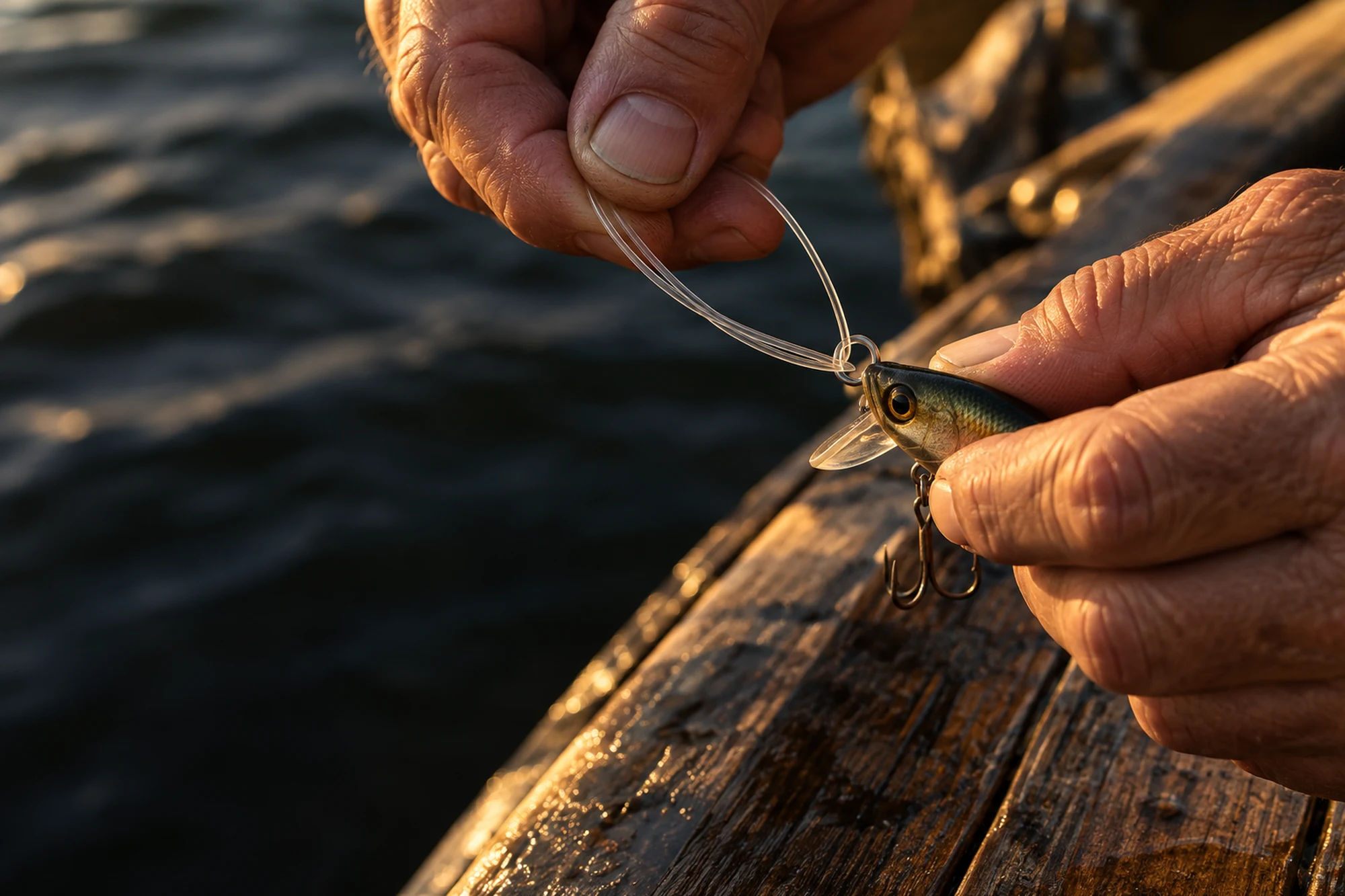
The Palomar is the strongest general-purpose terminal knot you can tie in under a minute. Most anglers tie it wrong — not because the steps are complicated, but because they skip the doubling step, pull the knot tight on a dry line, or rush the loop over a treble-hooked lure without watching it clear every hook point. Any one of those mistakes costs breaking strength. The combination costs fish.
Double the line first
The palomar requires doubled line. Not a single strand run through the eye — a doubled-back loop passed through as a loop. That is the structural core of the knot. It puts two strands of line through the eye instead of one, distributing load at the most vulnerable point in the connection before the overhand knot even forms.
Fold about eight inches of line back on itself so you have a doubled loop roughly four inches long. That loop — not a single strand, the loop — goes through the hook or lure eye. If the eye is small, wet the loop or use the tag end to coax it through. Either way: doubled loop through the eye, then proceed. Skipping this and threading a single strand is a different knot. It looks the same going in and fails sooner coming out.
Tie the overhand, then pass the loop over the lure
With the doubled loop through the eye and a few inches of slack above it, tie a loose overhand knot in the doubled section. Do not cinch it yet. The hook or lure hangs from the bottom of the loop at this point — let it hang. Keeping the overhand loose is what gives you room to complete the next step cleanly.
Extend the loop fully into a clear circle and pass it over the entire hook or lure. For a bare hook, the loop clears the hook point and bend. For a lure with treble hooks — and most jerkbaits carry two or three of them — the loop has to clear every hook, from the belly treble to the tail treble.
The treble pass-through problem
When the loop doesn't clear a treble hook completely, it catches on a hook point and the overhand knot rolls sideways on the eye. One side of the doubled line becomes the load-bearing strand; the other goes slack. The lure is still attached. The knot still seats. Under a hard pull — a headshake at the boat, a sudden direction change, a bass that decides to actually fight — that effectively single-strand connection fails well below rated breaking strength.
The fix is deliberate, not fast. After tying the overhand and letting the lure hang, extend the loop into a full clear circle above the bait and pass it over one treble at a time. Watch each hook point as the loop moves past it. The loop should sit cleanly behind the tail hook before you pull the knot tight. If it catches on anything, stop, reset, and pass it over again. This costs thirty seconds. It is worth more than retying with cold hands at the boat after the fish of the day has gone.
Wet it, then seat it
Wet the knot before you pull it tight. Saliva works. Fingers dipped in water work. What you are doing is lubricating the coils of the overhand knot so they can compress cleanly against each other instead of dragging. A dry palomar cinches on friction between line strands; that friction generates heat, and heat weakens fluorocarbon and mono at exactly the point where the knot is already under the most stress. Wetting eliminates the heat and lets the coils settle into their final position without binding against each other.
Pull slowly and evenly on the tag end and standing line together, increasing tension steadily. Seating is when the overhand knot compresses into a compact, immovable bump against the eye — not just tight, but settled. A palomar yanked tight without wetting will feel solid until a shock load shifts the coils somewhere they were not supposed to go. The difference matters most on fluorocarbon, which is stiffer and less forgiving about where its coils land under load.
Trim the tag end short after seating. Leave a visible stub — trimming flush gives a slipping knot no warning sign, and on braid or light fluoro that stub is the first tell.
Braid: pass the loop through twice
A standard palomar on braid holds most of the time. It can slip at the eye under shock load because braid is smooth and the contact surface at a small hook eye is smaller than you expect it to be.
The fix is passing the doubled loop through the eye twice: through once, bring the loop back around the outside of the eye, push it through again in the same direction. This doubles the contact points at the hook eye and gives the knot enough grip on a slick surface to hold under hard pressure. Everything after that follows the same sequence: overhand above the eye, loop over the hook, wet it, seat it, trim.
If you're running braid to a fluorocarbon leader — which is the standard jerkbait setup for most freshwater fishing — the palomar belongs on the leader end at the lure, not on the braid. Tie the braid-to-fluoro connection separately. The double uni covers that joint in full. Keep the palomar where it does its best work: fluorocarbon to lure, pulled tight against the eye.
Which line for a palomar
Mono is the most forgiving material for a palomar. Berkley Trilene XL is the benchmark here — supple, compresses cleanly, seats without the careful slow-pull that fluorocarbon demands. If you want to practice the knot before you need it on the water, mono is the right material to learn on.
Fluorocarbon is stiffer and the seating step matters more. Pull slower, wet more thoroughly, and confirm the overhand bump is locked against the eye before you trim. Seaguar Blue Label holds a palomar cleanly in leader weights from 10 to 25 pounds; its stiffness means you feel clearly when the knot is seated versus just tight, which is useful when you're learning what seated actually feels like.
Braid: doubled loop through the eye twice, as above. No exceptions on anything heavier than panfish weight.
For the full freshwater knot picture — improved clinch, Rapala loop knot, when each one is the right call — the Naughty Knots lake and pond guide covers them alongside the palomar. If you're also tying leaders for saltwater, the Naughty Knots saltwater guide has the FG knot and the knots that hold when a redfish decides to test all of them at once.
The full lineup of line and hardware is in line and hardware for jerkbaits if you are building the setup from scratch.
TL;DR — doubled loop through the eye, overhand loose, pass the loop over every treble until it clears completely, wet the coils before you seat them, pull slowly and evenly; braid needs the loop through the eye twice or it slips under load.