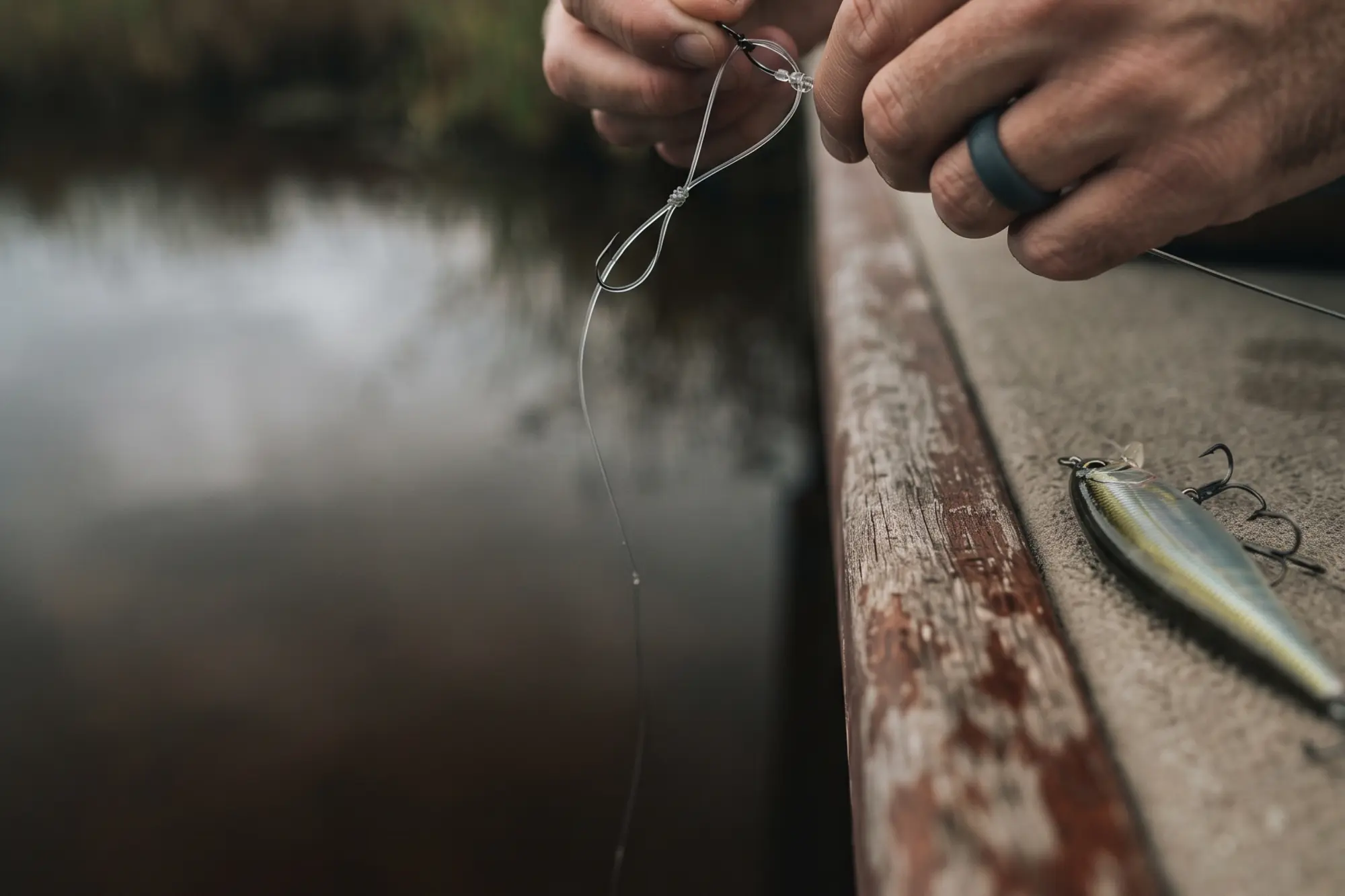
Freshwater knots get less credit than they deserve. You're not fighting a redfish run or a barnacle-covered piling, but you are fighting light line, a jerkbait that only works right if the knot doesn't choke its action, and a bass that will find the one wrap you rushed. Three knots cover essentially everything you'll tie on a lake or pond: one for general rigging, one classic backup, and one that exists specifically to make a suspending jerkbait dance the way it's supposed to.
1. The Palomar knot: tie this by default
If you only learn one knot, learn this one. The Palomar is simple, fast, and retains more of the line's rated strength than almost anything else you can tie in under thirty seconds, which matters, because every knot weakens the line at the point it's tied, and the Palomar weakens it the least.
- Double about six inches of line and pass the loop through the hook or lure eye.
- Tie a loose overhand knot in the doubled line, letting the hook hang at the bottom.
- Pass the loop over the entire hook or lure and let it fall past the bend.
- Wet the knot and pull both the tag and standing line to cinch it down snug, then trim.
This is the correct default for soft plastics and jigheads. Tie it on aZoom Super Fluke rigged weightless and you've got a connection that won't be the reason you lose a fish.
2. The improved clinch: the classic for a reason
Before the Palomar took over as the default, the improved clinch was the knot everyone's dad taught them, and it still holds fine in mono and fluoro when tied correctly. It ties directly off a single strand rather than doubled line, which makes it the better call when you're tying to a split ring or a swivel that a doubled Palomar loop can't fit through cleanly.
- Thread the tag end through the eye and make five to seven twists around the standing line.
- Pass the tag end back through the small loop just above the eye.
- Then pass it through the larger loop you just created.
- Wet it, pull it snug evenly, and trim the tag.
Five wraps for heavier line, seven for light line: more wraps compensate for line that's too thin to bite into itself as hard. Spool up with something forgiving likeBerkley Trilene XL monofilament and this knot will hold all day without babying it.
3. The Rapala loop knot: the one that actually matters for jerkbaits
Here's the knot most anglers skip and shouldn't, because it's the one that changes how your bait actually swims. A suspending jerkbait is designed to kick side to side on the pause, and that side-to-side wobble is most of what triggers a strike from a fish that's just watching. Cinch a Palomar or clinch knot down tight against the split ring or tow eye and you choke that motion. The line pinches the eye and restricts the bait's natural roll. A loop knot leaves a small fixed loop instead, letting the lure swing freely on the connection: full range of motion, full action, exactly what the bait was designed to do.
- Tie a simple overhand knot about six inches up the line, leaving it loose, and pass the tag through the lure eye.
- Pass the tag end back through the overhand knot from the same side.
- Wrap the tag around the standing line three to five times.
- Pass the tag back through the original overhand knot, then through the new loop it created.
- Wet it and pull it down slowly, adjusting the loop size against the eye before it locks. That loop size is the entire point, so don't rush the last pull.
This knot earns its keep specifically on suspending hard jerks:Rapala Husky Jerk 12 and similar balsa baits show the difference most obviously, because their entire cold-water appeal is the subtle dying-baitfish roll on the pause, and a cinched-down knot is the fastest way to kill it without even realizing you did.
Fluoro or mono: pick based on what the knot has to do
Fluorocarbon is nearly invisible underwater and has almost no stretch, which telegraphs the bite better, but it's stiffer and less forgiving on a loop knot that needs to swing freely. Mono is more supple and gives a loop knot slightly more natural movement, at the cost of a little more stretch on the hookset. If you're building a leader specifically to run a Rapala loop knot,Seaguar Blue Label fluorocarbon leader still ties a clean loop and adds the stealth that clear lake water rewards.