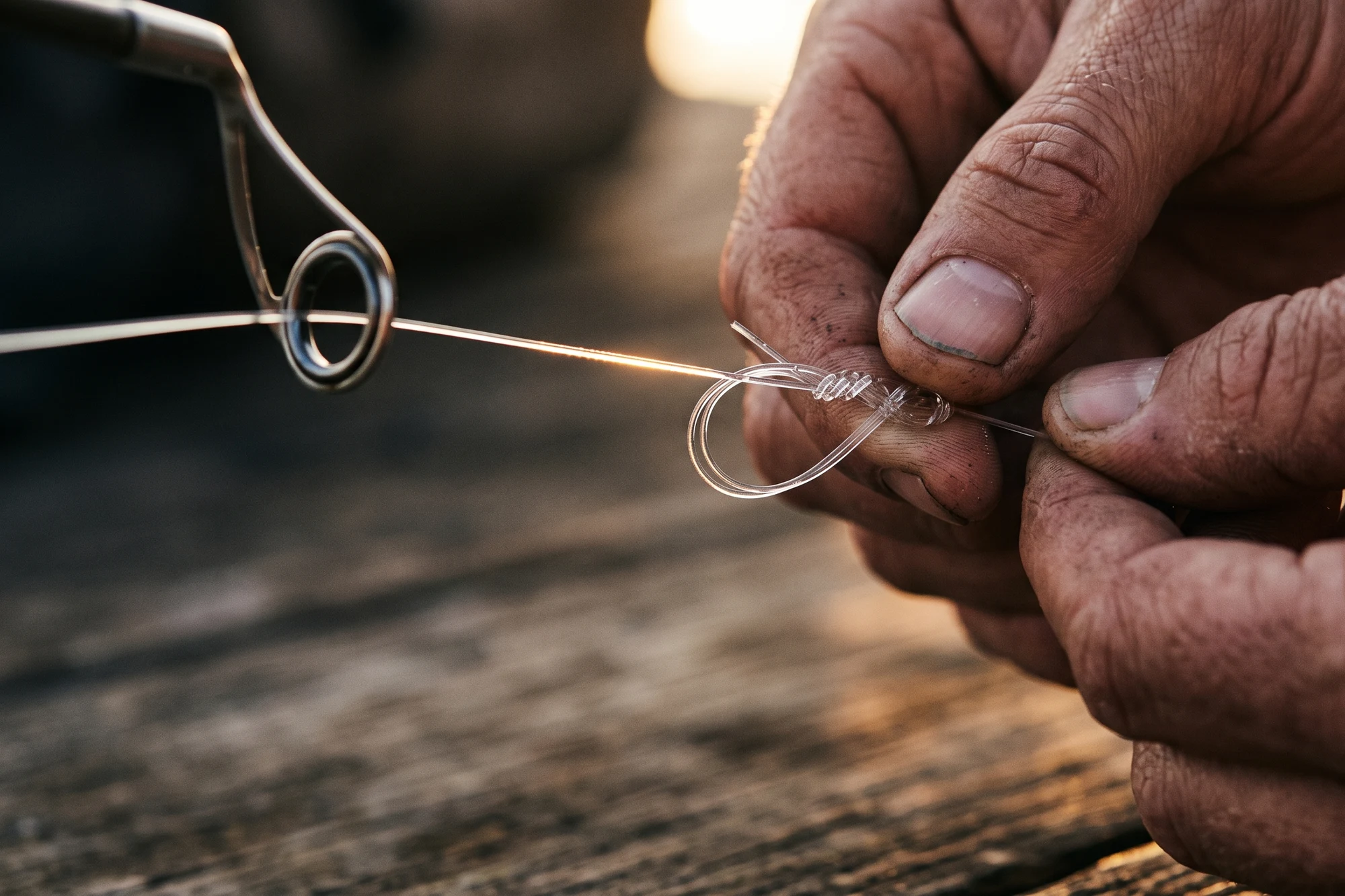
The problem with a clinch knot on a jerkbait
A clinch knot cinched tight against a lure eye does exactly what it is supposed to: it holds. That rigid connection is an asset on most lures. It is a liability on a suspending hard jerkbait.
Here is why. A jerkbait like the Rapala Husky Jerk works because of what happens on the pause. After you jerk it, the bait glides forward and then stops — and in that stop, it rolls slightly, wobbles, and hangs. That roll is the triggering motion. It is the thing that makes a bass watching from twelve feet below decide to commit. Cinch a knot against the tow eye and you kill it. The line goes rigid at the pivot point and the lure cannot complete the motion. The action is dampened exactly where the action matters most.
This is not a subtle difference. Find clear, shallow water and watch a suspending jerkbait on a tight clinch beside one on a loop. The loop version finishes its roll. The clinch version stops short and sits there.
What the non-slip loop actually does
The non-slip mono loop — sometimes called the Rapala knot — ties a small, fixed loop at the end of the line. The lure eye sits inside that loop and moves freely. There is no direct line-to-eye contact. The bait swings on the connection. When you jerk, the bait kicks. When you stop, the bait rolls through its full arc and then dies.
The loop is fixed, not adjustable. Once you snug it down, the loop sits at a set diameter — large enough for the lure eye to swing inside, small enough that it does not flop around and tangle on the cast. That size is set during tying and stays there. It does not grow under load. It does not collapse to nothing under load. It is a stable, functional connection that happens to give the lure room to move.
Give it room to move. That is literally the job.
How to tie it
Six steps. Read them once before touching the line.
- Tie a loose overhand knot about eight inches from the tag end. Leave it completely open — it is a fulcrum, not something you cinch here.
- Pass the tag end through the lure eye from below and let the lure hang.
- Pass the tag back through the overhand knot, entering from the same side it left.
- Wrap the tag around the standing line five times, moving away from the eye. Keep the wraps side by side and uniform.
- Pass the tag end back through the overhand knot, same direction as before.
- Pass the tag through the large loop that formed between the overhand and the eye.
Wet the whole knot. Hold the standing line and the lure and pull steadily in opposite directions. The overhand will creep toward the eye and lock once the loop can no longer reduce. Stop there. The finished loop should have roughly a quarter inch of clearance — enough that the lure eye moves when you nudge it with a fingernail, not so much that it flops and tangles on the forward cast.
Five wraps is correct for 10- to 17-pound-test mono or fluorocarbon. Below 10-pound-test, add a wrap or two. Above 17, the line has enough surface area per wrap that four wraps hold cleanly — more than that and the stiff line will not lay flat without a fight.
Why you do not cinch the loop down
The loop is load-bearing. That sentence needs to land before the next one, because the instinct when finishing any knot is to pull everything tight and trim flush.
If you pull the loop closed against the eye before fishing, you have made a worse clinch. The loop collapses to the eye diameter, the line contacts the eye directly, and the bait is now restricted — the same problem you were solving, with extra steps to get there.
The gap inside the loop is structural. Under the load of a strike, the loop will close down to the eye and hold — that is fine and correct, because the knot is designed for that load. What you are protecting against is the bait's motion being restricted when there is no load. That free movement is what makes the bait work.
Trim the tag to a quarter inch. Not flush — a small stub prevents the knot from pulling back through its wraps on a hard strike, and leaving a sliver of tag costs you nothing.
When to go back to a clinch
The non-slip loop is correct for a hard jerkbait worked in open water. It is not the universal answer.
Go back to a Palomar or improved clinch when the connection point is going to take physical contact. Deep crankbait fishing puts the tow eye against rocks and wood on every cast. A swinging loop has more surface area to pick up damage, and it does not track as cleanly through tight structure. A rigid Palomar is the right call.
Bottom-contact rigs — Carolina rig, drop-shot, any presentation where the terminal end drags across gravel — foul with a loop knot. Cinched is cleaner and less likely to pick up debris on the retrieve.
Lipless rattlebaits are a borderline case. Their action is built into the body shape rather than lure-end pivot, so a loop does not hurt, but a Palomar does not noticeably hurt either. Use whichever you tie faster.
The suspending jerkbait category is where this knot is non-negotiable. A Megabass Vision 110 Jr. on a tight clinch and a Vision 110 Jr. on a non-slip loop are not the same lure during the pause — and the pause is when fish bite.
Line choice
The non-slip loop ties cleanly in monofilament and fluorocarbon from about 8- to 20-pound-test. Below 8, getting the wraps to snug to a consistent loop diameter is tedious. Above 20, the stiff wraps become their own problem.
Fluorocarbon is the standard choice on a jerkbait — it sinks, has almost no stretch, and disappears in clear water. Seaguar Blue Label is the short-spool leader material in this site's catalog and ties a clean non-slip loop. Berkley Trilene Fluoro Leader is the lower-priced option in the same build.
The non-slip loop does not work in braid. Braid's smooth surface gives the wraps too little to grip and the knot will pull through under load. Run braid to a fluorocarbon leader — the double uni guide covers that connection — then tie the non-slip loop at the leader-to-lure end.
For the broader freshwater knot toolkit — Palomar, improved clinch, and where the loop knot fits among them — the lake and pond knots guide has the full context. The terminal setup — braid, fluoro leaders, hardware — is in line and hardware for jerkbaits.
TL;DR — non-slip mono loop on every suspending hard jerkbait · five wraps in 10-17 lb test, adjust up for lighter line · do not cinch the loop closed · Palomar or improved clinch when the connection takes physical contact with structure.