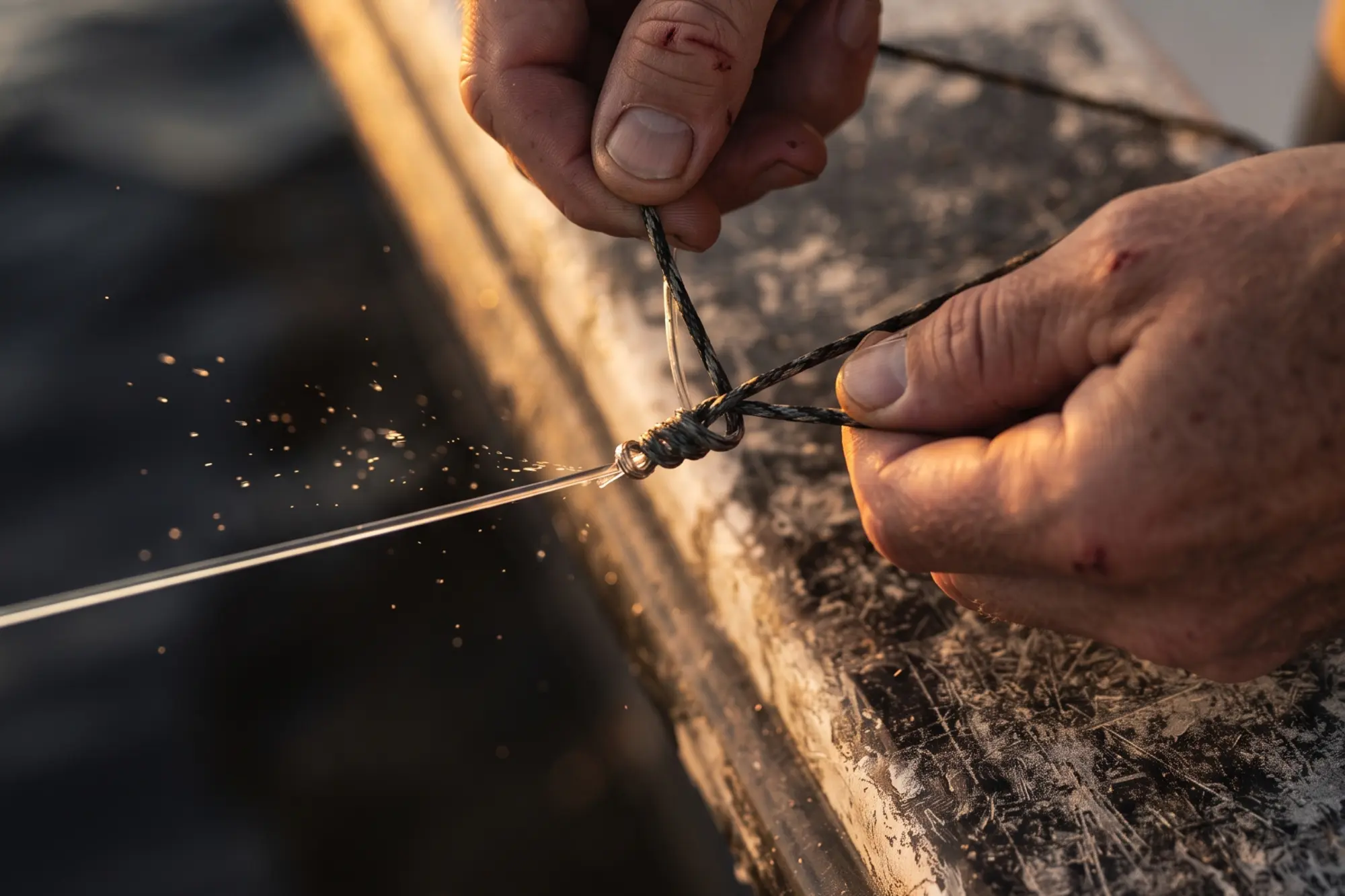
A freshwater bass will occasionally forgive a sloppy knot. A redfish tailing on an oyster bar, a jack crevalle doing its best chainsaw impression, or a king mackerel that finds the one inch of your leader that touched a barnacle will not. Saltwater does not care how good your cadence is if your connection fails on the first real run. This is the short list: three knots, no filler, that actually holds up out there.
1. The FG knot: your braid-to-leader standard
If you fish braid to a fluorocarbon or mono leader in saltwater, the FG knot is the one to learn properly and never stop using. It is not a knot in the traditional sense: it is a friction weave, braid wrapped around leader under tension, that ends up thinner and stronger than almost anything else you can tie by hand. A good FG knot will pass clean through your rod guides on the cast, which matters more than you think when you're bombing a topwater at structure sixty yards out.
- Hold the leader taut, a rod tip clamped under your arm or a helper works fine.
- Wrap the braid over and under the leader, alternating sides, 15–20 wraps, keeping tension on both lines the entire time. This is the part people rush. Don't.
- Lock the wraps with a few half-hitches of braid around the leader.
- Finish with a few more half-hitches back through both lines, trim close, and singe the tag end if you're using mono (not fluoro, it doesn't respond the same way to heat).
Run this on a wire or heavy mono leader ahead of a knottable saltwater leader likeAFW Surflon nylon-coated leader wire and you've got a connection that shrugs off structure and teeth in the same cast.
2. Uni-to-uni: the easier alternative that still holds
Not everyone wants to tie an FG knot standing in a rocking boat with a bait pump running. Fair. The uni-to-uni is the practical backup: two uni knots tied into each other, braid on one side, leader on the other. It's bulkier than an FG (it won't cast as clean through guides) but it ties in under a minute even with cold hands and it holds real weight.
- Overlap the last six inches of braid and leader, running parallel and pointed opposite directions.
- With the braid tag end, make a loop around both lines and wrap through the loop five to seven times, then cinch down.
- Repeat with the leader tag end around both lines, same wrap count, cinch down.
- Pull the two uni knots together until they lock, then trim both tags.
Spool up with a proper leader material, something likeBerkley Trilene Big Game Mono gives you seventeen hundred yards of shock-resistant leader stock, which is more than enough to re-rig all day without rationing it, and the uni-to-uni will get you fishing fast.
3. The snell knot: mandatory for circle hooks
This is the one saltwater anglers skip and shouldn't. A circle hook does not work right tied with a standard clinch knot to the eye. The geometry that makes a circle hook set itself depends on the leader pulling from the correct angle along the hook shank, not straight off the eye. A snell knot wraps the leader down the shank itself, which keeps that angle correct when a fish loads up and swims off with the bait. Tie a circle hook with a clinch knot and you'll pull a lot of hooks clean out of fish that should have been pinned. We wrote the whole physics breakdown separately. Read When not to jerk: a circle hook interventionif you want to understand exactly why the hookset itself has to change, not just the knot.
- Run the leader through the hook eye, leaving several inches of tag end past it.
- Hold the tag against the hook shank and make five to seven wraps down the shank, working away from the eye, trapping both the tag and standing line under each wrap.
- Pass the tag back through the eye from the same side it came from.
- Wet it, cinch it down snug against the eye, and trim.
Wire leaders deserve their own knot conversation
Toothy fish change the math. A knot that holds fine in mono or fluoro can still get sawed through by a Spanish mackerel or a bluefish before it ever fails structurally. When you're running bare or coated wire instead of mono leader, you're generally crimping rather than tying. Asingle barrel crimp sleeve compressed with the right tool is stronger and more consistent than any hand-tied knot in wire, and it's the standard for exactly that reason. Know both: hand-tied for mono and fluoro, crimped for wire, and you're covered for whatever's biting.