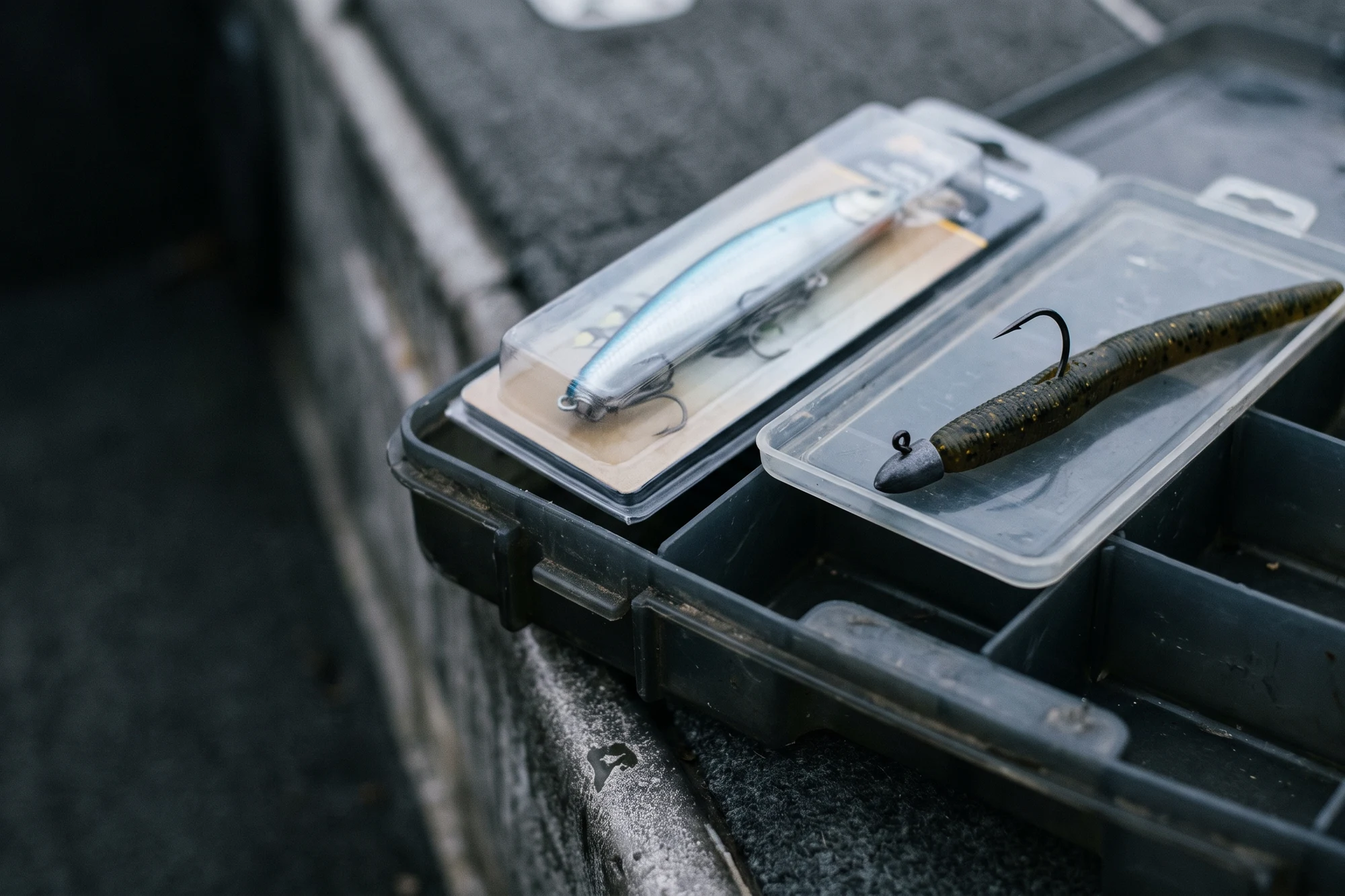
The pause is the whole technique
Jerkbaits catch fish on the pause. The rod snaps, the lure darts and rolls, and then it stops — hanging in the water column, looking like something injured and easy. That hang is not decoration. It is the strike trigger. Bass and walleye commit during the pause, not during the dart.
Everything about a quality suspending jerkbait is engineered for that moment. The weight placement, the internal rattle, the hook positioning — all calibrated to produce a specific behavior: neutral buoyancy at a target depth, holding position when the line goes slack, moving only when you move it. The technology exists specifically because the pause matters.
This matters because once you are in heavy current, none of it applies.
What current does to the pause
Suspending behavior requires slack line. When the bait darts and you stop pulling, the line goes momentarily limp, and the bait — balanced to be exactly neutral — holds its position. That is the mechanic.
In current, the line does not go slack. Moving water presses against the line across the entire section between your rod tip and the bait. Simultaneously, the current is pushing against the bait body itself. The bait is not in slack water where it can hold position. It is in a medium that is actively moving it.
The result: the bait does not suspend. It sweeps. As soon as you stop the retrieve, the current takes the line and swings the whole rig downcurrent on a tight bow. The lure moves not because you are making it move, but because the river is making it move. And unlike a retrieve, this movement is steady, straight, and predictable — nothing like the erratic dart-and-pause that makes a suspending jerkbait worth throwing.
The neutral buoyancy of an SP bait actually makes this worse. A floating jerkbait would at least rise toward the surface during the swing. A slow-sinker would at least drop. An SP bait does neither — it swings broadside through the current at exactly the depth the water wants to hold it, with no variation, no hesitation, and nothing resembling a pause. You are not fishing a jerkbait. You are dragging a lure-shaped object through moving water on a tight line.
The F, SP, and S designation matters a great deal in still or slow water. In heavy current, that designation is irrelevant — the water column behavior you paid for does not exist in this environment.
What the fish actually sees
A bass or walleye holding in current — parked behind a rock, in the eddy behind a bridge piling, along the slack side of a current seam — sees something moving in one direction, at one speed, and at one depth. No dart. No flash from a hard direction change. No moment of vulnerability where the bait stops and the fish can commit.
A jerkbait in current fishes like a crankbait with worse action, less vibration, and the wrong hook spacing for the technique. River bass and walleye have been watching baitfish navigate the same flow all day. A real injured shad or sucker in current does something recognizable: it stalls, flutters against the flow, drops sideways, clears the pressure in short erratic bursts. A jerkbait on a tight downcurrent swing does none of that. It just moves downstream at a steady pace because the river told it to.
You might get hit. A reaction strike happens sometimes regardless of presentation. But you are giving the fish the worst possible version of what jerkbaits do, in conditions where they were not built to operate. The strikes you do get are not evidence the technique is working — they are evidence that fish occasionally eat things that barely resemble food.
What to throw instead
The presentations that work in current share a property: they do not require a slack-line pause to do their job. They work on the swing, they can be ticked along bottom, and they look alive in moving water without any help from the angler.
Paddle-tail swimbait on a jighead. This is the starting point for moving water bass and walleye. A 3.5- to 4-inch paddle tail on a jighead between 1/8 and 3/8 ounce — weighted enough to reach the bottom and hold position without being swept immediately downcurrent — works across current seams, through eddies, and along riprap banks. The tail is moving because the water is moving. You are not fighting the current; you are using it. The Keitech Swing Impact FAT is the standard here: enough salt content that it does not feel hollow in the water, a paddle tail that thumps at low retrieve speeds, and a profile that looks like something that actually lives in rivers.
Cast upstream or cross-current. Control depth with jighead weight — just enough to stay near bottom without constant hangups. Reel slowly and let the swing do the work. Current hits usually feel like a pull rather than a tap, and they happen early in the swing when the bait is still cross-current and visible from the best angle.
Hair jig or marabou jig. Particularly strong for river smallmouth and walleye. A 3/8- to 1/2-ounce jig with a marabou tail breathes in current in ways rubber and plastic cannot replicate. Ticked along the bottom through a run or swept through a pool, the hair is moving even when the jig is stationary. The fish does not need the jig to perform an action; the current performs the action. The right hair jig for a specific run depends on current speed (heavier in faster water), water clarity (darker in stained conditions), and target depth — which is why no single product covers it. What matters is the material. Rubber sheds water; marabou holds it and keeps moving.
Slow-rolled fluke or minnow shape. A Zoom Super Fluke on a 3/16-ounce weighted swimbait hook can be slow-rolled through moderate current seams without a dedicated jighead setup. Less bottom contact than a jighead rig, more flutter on the swing, better in moderate flow than in heavy push. In the right conditions — water moving but not ripping — it reads more naturally than a rigid paddle tail.
In all three cases, the retrieve philosophy is the same: work with the current, not against it. Position the boat or yourself to cast upstream, let the bait come across and downstream, and control depth and speed. The fish are facing upstream waiting for food to come to them. Give it to them.
The knot changes too
Heavy current puts constant load on a knot in a way still water does not. The stream and river knot guide covers this specifically, but the short version: tie tighter, wet every wrap before cinching, and inspect the connection more often. A knot that holds fine in still water can fail progressively under sustained current tension that you never notice until the fish is already off.
The jerkbait stays in the box
This is not about the jerkbait being a bad lure. In still or slow water — a reservoir flat, a lake point, a slow oxbow — a suspending jerkbait is one of the best presentations in freshwater. Jerking 101 applies perfectly in the right venue. Cold-water bass on a second ledge, walleye suspended over a deep hump, late-fall fish stacked on a main-lake flat: these are jerkbait situations.
Moving water is not an adjustment you make to jerkbait fishing. It is a different technique category with different physics and different tools. Reaching for a jerkbait on a river or a current-swept bank is not an adaptation; it is a refusal to recognize that the conditions have changed what the job requires.
The fish in moving water want something that makes sense in current. They have been watching baitfish navigate the same flow all day. They know what a struggling shad looks like getting swept through a seam. Your jerkbait on a tight downcurrent swing is not that.
Keep the jerkbait for flat water. When the current is strong enough to bow your line between rod tip and lure, put it down and pick up something that uses the river instead of fighting it. The soft-jerks section has the swimbaits and plastics worth rigging when the water starts moving.