The depth you keep finding
Hit the first point and mark fish at 14 feet. Motor to the next one and mark fish at 14 feet. Drive across the lake to a hump where the bottom is at 28 feet and mark fish at 14 feet. That is not a coincidence. That is the lake telling you something about the water itself.
A thermocline is where the water column divides into layers that stop mixing. By August in most freshwater lakes, the surface runs 82 to 86 degrees. Bass prefer somewhere in the 65 to 72 degree range. Below the thermocline, the temperature is right but the oxygen is gone: the cold, deep layer loses dissolved oxygen through biological processes over the course of a summer until it sits below 4 parts per million, which is the threshold where most gamefish cannot function for long. The result is a narrow band just above the thermocline where the temperature has dropped into a tolerable range and the dissolved oxygen is still adequate. Every bass, walleye, and perch in the lake is competing for that floor.
The forage stacks there too. Baitfish follow the same oxygen and temperature gradient. The whole shad or perch population concentrated at one depth means a predictable food source for anything that can survive just above the line. The fish are not scattered. They are right where the chemistry put them.
What the thermocline looks like on your fish finder
Most modern sonar units will show the thermocline as a faint horizontal return somewhere in the water column. It is not a sharp bottom return. It looks like a soft gray band: thicker than a fish arc, lighter than hard bottom, with some texture rather than a clean edge. The key feature is that it appears at the same depth across the entire lake regardless of what the bottom is doing. Check a 22-foot flat and a 40-foot basin and the band sits at 14 in both.
To see it clearly, increase your unit's sensitivity or sonar gain by 20 to 30 percent above your normal setting. The layer will sharpen. Fish appear as arcs sitting tight to the upper edge of that return, not below it and not scattered through the column above.
If you cannot see the layer at all, that is also useful information. A lake with no thermocline is still mixing and fish can hold anywhere in the column. A thermocline sitting very shallow, at 6 to 8 feet, usually means the lake has stratified for an extended period and the hypoxic zone below it is expanding upward, compressing the livable water even further.
Why a deeper jerkbait does not fix this
The instinct makes sense. The fish are at 14 feet and your bait runs at 6, so get something that dives to 14. But this misreads the actual problem.
Take a Rapala Shadow Rap Deep. On a long cast with 10-pound fluorocarbon and the rod tip angled down, it can reach that depth. The diving part is possible. The problem is what happens after it gets there.
In spring, a jerkbait running through a school triggers lateral strikes. The fish are metabolically active, water temperatures are rising through their preferred range, and bass commit to moving targets because the season is built for it. The cadence works because the fish are evaluating and reacting.
In August, fish parked at the thermocline ceiling are waiting out the season. They are not in a reactive state. The surface is too warm, the deep water has no oxygen, and they are staged at the one depth where both variables are tolerable. A jerkbait asks the fish to commit to chasing something that darts and pauses through the water column. A bass wedged against the thermocline in 86-degree August will not rise 3 feet upward through warmer water to chase a jerkbait the way the same fish does in April. You can vary the cadence, extend the pauses, slow the whole retrieve down. The fish are not evaluating it. The application is wrong, not the lure.
Post-front conditions lock fish down in a similar way, and the finesse switch that works there applies here too: get the bait to the fish rather than try to get the fish to come to the bait.
Presentations that actually reach the zone
The common requirement in everything that works is depth control. You need to put the bait at 14 feet, or wherever the thermocline is sitting, and keep it there long enough for a fish to eat it. Not run through that depth once and come back up. Not flutter above it.
Drop shot. A 3/8-ounce drop-shot weight on 10-pound fluorocarbon, with a hook tied 14 to 18 inches above it on a Palomar knot, parks the bait at a fixed point in the water column while you shake the rod tip. The weight sits on bottom at whatever depth you are fishing. The bait hangs in the zone. A Yamamoto Senko drop-shotted straight through the nose produces enough subtle pulse on a light shake to read as alive without requiring the fish to move to intercept anything. In summer thermocline conditions this is the highest-percentage presentation for bass that have stopped chasing: put the bait at their depth and barely move it.
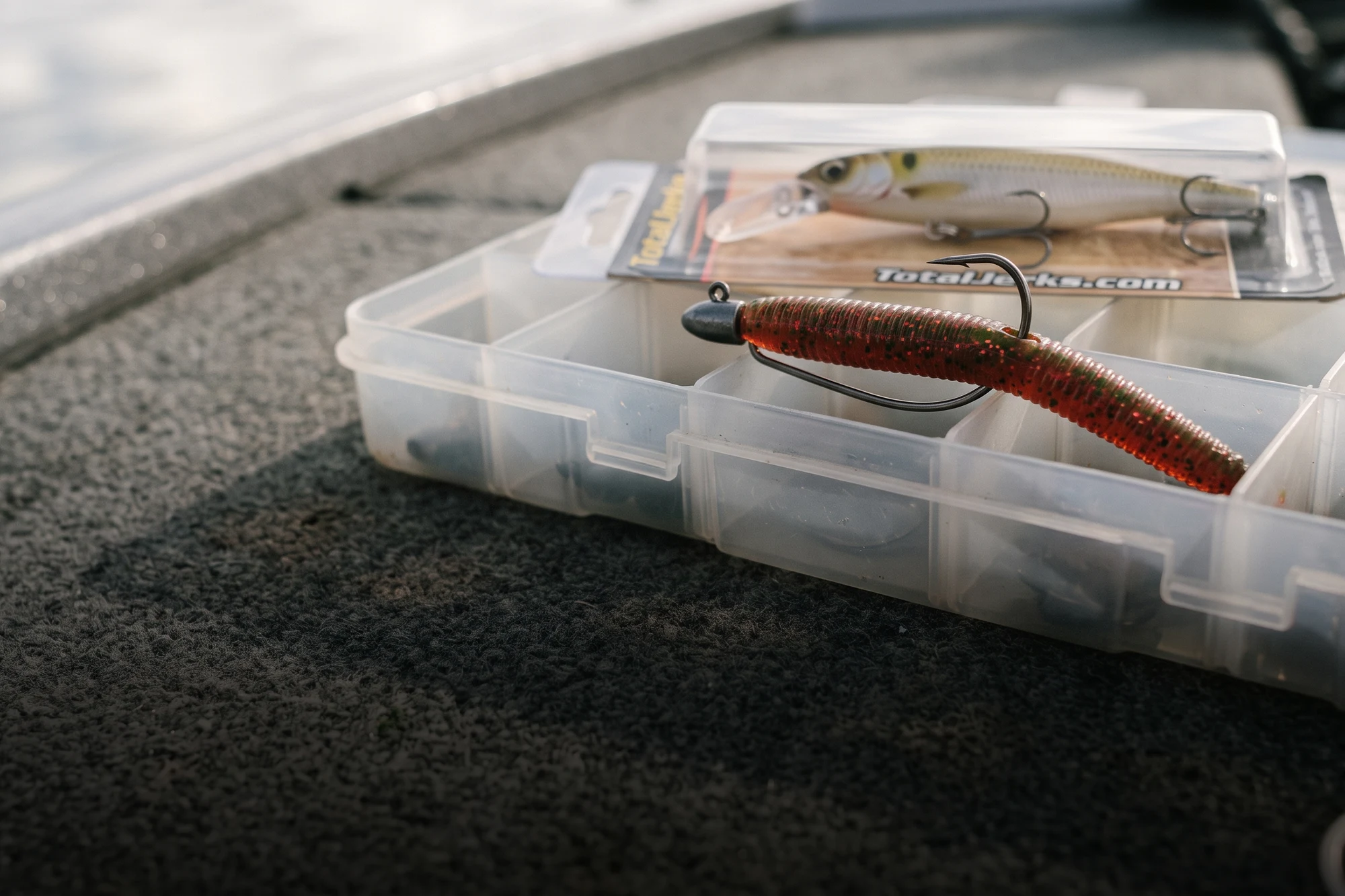
Shaky head. A 3/16-ounce shakey-head jig with a 4-inch finesse worm threaded nose-down puts the bait on the bottom at the right depth with the tail floating up. Drag it slowly. Shake it in place. The fish is not going to come to you. A Z-Man TRD TubeZ on a shakey head maintains its action on almost no movement and the ElaZtech material pulses on vibration alone. Use 6- to 8-pound fluorocarbon on a light-action spinning setup. Summer thermocline bites are soft and heavy, not sharp taps, and heavier line costs you fish on this presentation.
Deep-diving crankbaits. A lipped crankbait rated to reach 12 to 15 feet on a long cast and hold that depth on a steady retrieve is a fundamentally different tool than a jerkbait. The retrieve is constant, not cadence-based: you are not jerking and pausing, you are just turning the reel. Fish that will not commit to a darting bait sometimes eat a crankbait that runs steadily through their zone and displaces water at a consistent wobble frequency. No deep-diving crankbaits in this depth range are in the catalog yet. Any lipped crankbait with a published diving depth of 12 to 15 feet on 10-pound line covers this scenario. The vibration profile reads differently enough from a jerkbait that it produces from fish who have stopped evaluating reaction baits.
Carolina rig. A 3/4- to 1-ounce bullet sinker on a barrel swivel with a 24- to 36-inch fluorocarbon leader and a soft plastic crawled slowly along the bottom at the right depth is the most patient version of this solution. The weight drags on the bottom. The bait drifts and falls above the sinker on the leader, right at the thermocline ceiling, and releases scent on every inch of the retrieve. A Keitech Swing Impact FAT on a Carolina rig combines a thumping paddle-tail action that fish can feel before they see it with squid scent that gives them something to commit to. Slow the retrieve further than feels necessary. The fish are not chasing.
The honest answer
When the whole lake stratifies in summer, the problem is not your lure. The jerkbait is fishing exactly where it is designed to fish. The fish moved to a different floor because the water chemistry forced them there, and that floor is not where a jerkbait operates.
Read your sonar until you can see the diffuse band. Note the depth. If the fish are stacked just above it across multiple spots and the surface temperature is above 78 degrees, the jerkbait stays in the rod locker. The correct gear for this situation is at /little-jerks/finesse/ and /soft-jerks/weightless/.
The cold-water version of this calculation runs in the other direction: fish that want to react but need a slower cadence to commit. That is a completely different problem from fish that have stopped evaluating moving targets because August is making them survive at 14 feet.
One more thing: the thermocline breaks down in fall when the surface cools toward the deep-water temperature and the lake turns over. When that happens the fish scatter and a jerkbait becomes one of the best tools on the water again. The window closes in August and reopens in October, give or take the weather. Mark your calendar.