If you fish jerkbaits the way you fish crankbaits, you will catch fewer fish. Crankbaits work on the reel. Jerkbaits work on the rod. The reel exists only to gather slack between jerks. Almost every common mistake with this category traces back to that one misunderstanding.
Here is the technique broken down.
What "jerking" actually means
A jerk is a sharp downward motion of the rod tip, usually four to eight inches. It is not a sweep. It is not a long pull. It is a controlled, almost percussive snap that imparts a darting motion on the bait (left, right, sometimes a half-spiral) that imitates a wounded baitfish trying and failing to swim straight.
The pause that follows is doing the actual work. The jerk is the alarm. The pause is the invitation.
The classic cadence: jerk · jerk · pause
The most universal cadence is two jerks and a pause. The pause length varies by water temperature and fish mood:
- Warm water (65°+): 1–3 second pause. The fish are aggressive; they will come get it.
- Mid water (50°–65°): 3–6 second pause. The fish are interested but evaluating.
- Cold water (under 50°): 6–15 second pause. The fish are evaluating slowly. Be patient or be empty-handed.
Three jerks and a pause is also valid, particularly with longer baits. One jerk and a pause is a finesse cadence, try it when the standard two is getting follows but no commits.
Rod tip position: four o'clock, not nine
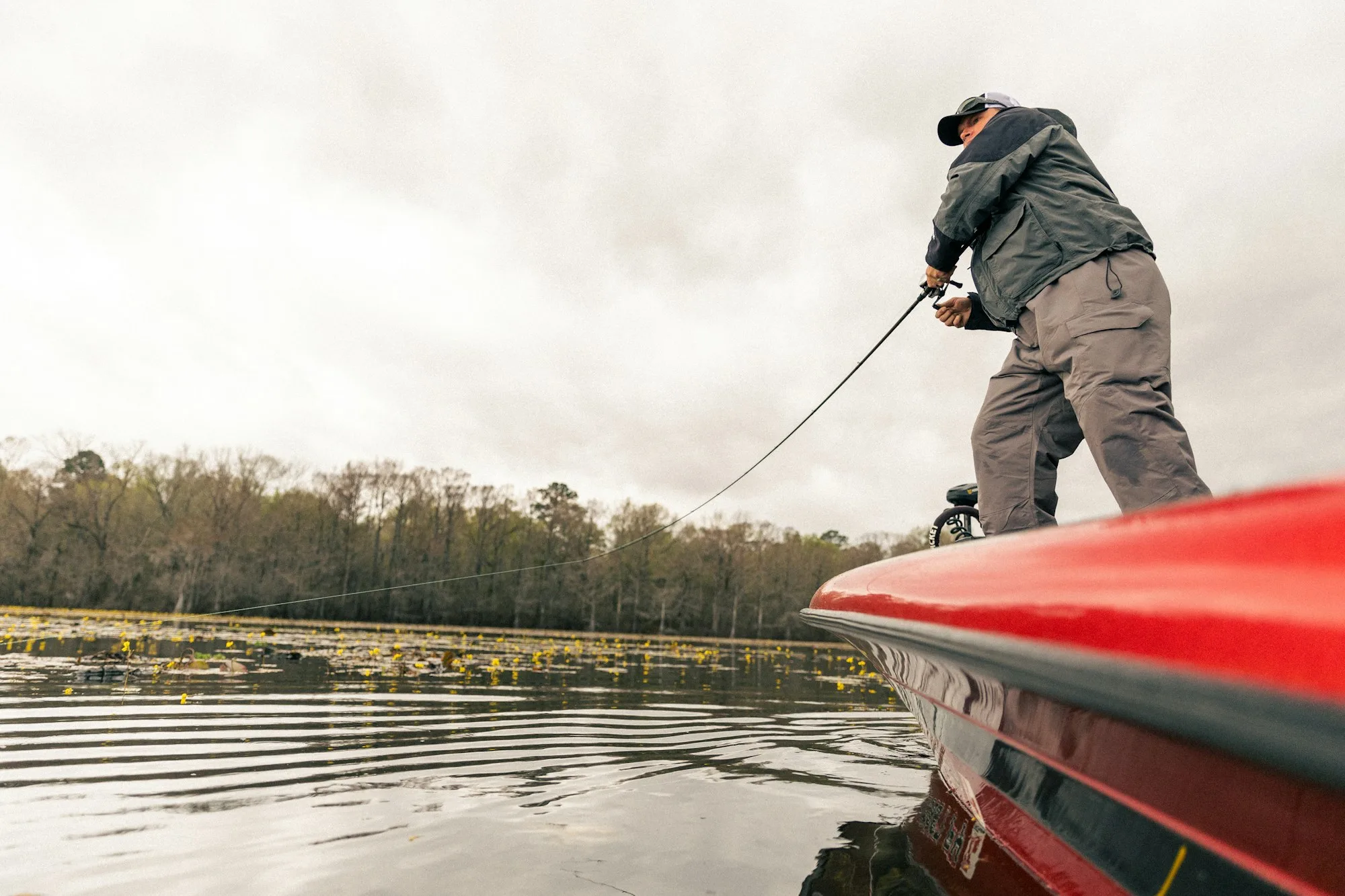
Keep the rod tip low. Pointing it at 4 o'clock, angled down and slightly to the side, gives you the right geometry for sharp downward jerks. A high rod tip turns every jerk into a sweep, which lifts the bait toward the surface and pulls it out of the strike zone.
Many guides will tell you to fish jerkbaits with the rod pointed straight at the bait. They are not wrong. The 4 o'clock variant gives slightly more control on the hookset, which matters more in cold water than in warm.
Line management: slack between jerks is mandatory
This is the part most anglers get wrong. After the second jerk in a two-jerk cadence, there should be visible slack in your line. The bait cannot suspend, cannot do the work, if the line is tight. A tight line drags the bait, killing the action.
Reel only enough between cadence cycles to pick up the slack you generated. If you find yourself reeling continuously, slow down.
Soft jerks vs. hard jerks: same cadence, different feel
The cadence is identical. The feel is different. Hard jerkbaits (Megabass, Rapala, etc.) telegraph the jerk back through the rod, you can feel them dart. Soft jerkbaits (Zoom Super Fluke, Yamamoto D-Shad) are nearly weightless and require trusting that the bait is doing what you asked it to. New anglers often jerk soft baits too hard. Half the motion is usually right.
When to twitch instead of jerk
A twitch is a smaller, faster motion: an inch or two of rod tip movement, fast and repeated. Twitches are useful when fish are following but not committing. The bait stays in roughly the same column but generates more visual chaos. Try a twitch-twitch-twitch-pause sequence when a clean jerk-jerk-pause is producing follows.
The four most common mistakes
- Reeling during the pause. The pause is the bite. Do not steal it from yourself.
- Rod tip too high. Drop it. Four o'clock.
- Jerks too soft. A clean jerk is a snap, not a tug. The fish is reacting to the abrupt darting motion.
- Setting the hook on the jerk. Wait for tension. In cold water, the fish often has the bait for one to three seconds before you feel anything. A hookset on the jerk pulls the bait away from a fish that was about to commit.
Three rods worth jerking with
- Shimano Zodias 6'10" ML Jerkbait is the rod that teaches cadence. Fast tip, light action, weight where it counts.
- St. Croix Mojo Bass Jerkbait 6'10" MF is American-made, soft-tip, made-in-the-USA confidence.
- Shimano Trevala S for the vertical jerks (jigging spoons, slow-pitch jigs). Same principle, different orientation.