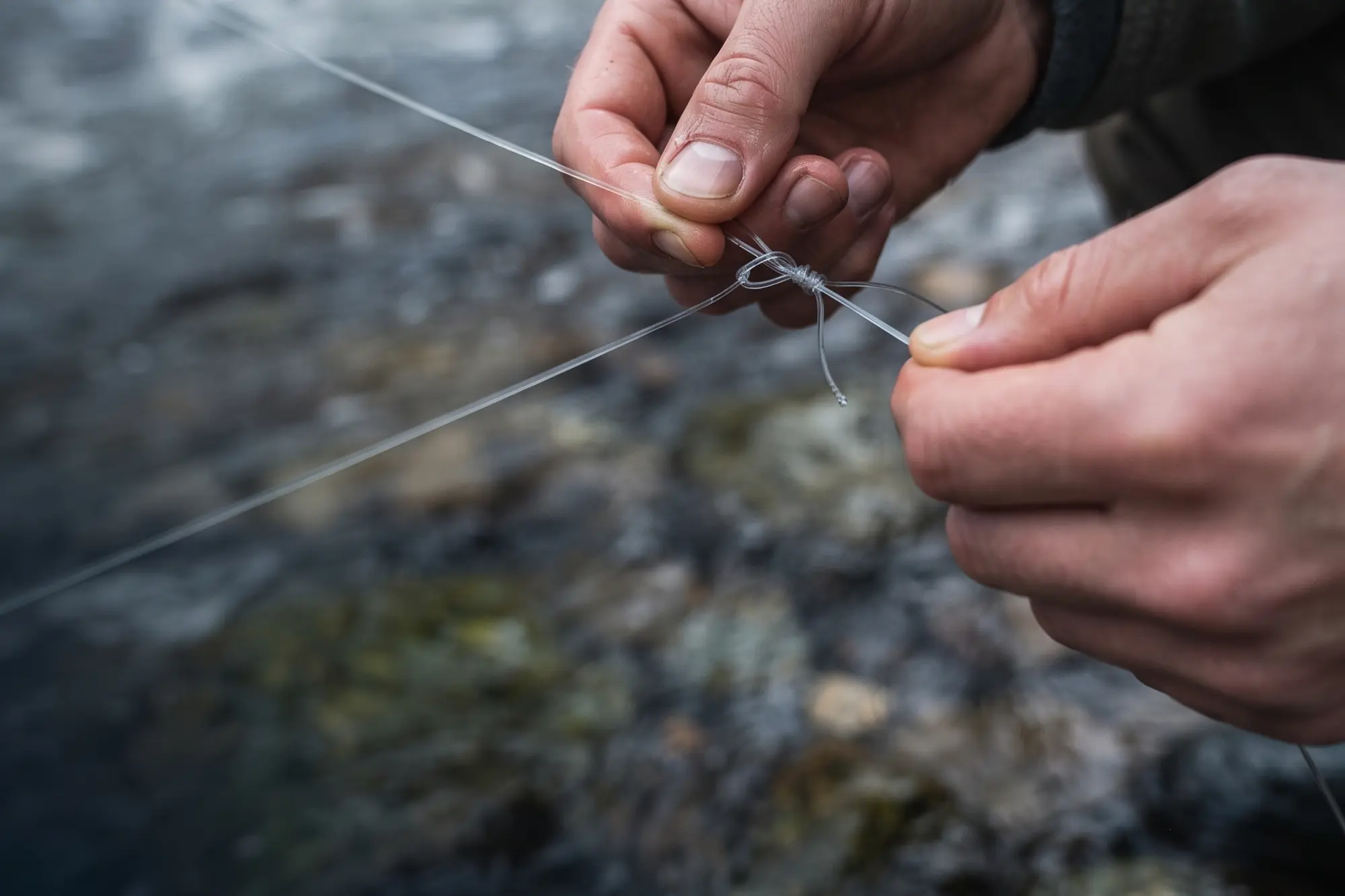
A stillwater fish gets one shot at your knot: the hookset. A stream fish gets thousands. Every second your line sits in current, the flow is pulling, sawing, and flexing the exact point you tied it, long before anything even bites. That changes which knots earn a spot in your kit. You don't want the strongest knot on the water. You want the fastest strong knot, because you're going to be tying it again in twenty minutes whether you like it or not.
1. The surgeon's knot: for when you're standing in the river, not sitting at a bench
This is the knot for swapping leader material mid-wade: tippet's shredded on a rock, you want to step down a pound test for spookier water, or you're switching from a small hard jerk to something with a lighter bite. The surgeon's knot ties two lines of different diameter together without a single wrap count to remember, and you can tie it one-handed with a rod tucked under your arm.
- Lay the tag end of your old leader alongside the new material, overlapping four to six inches.
- Treat the two overlapped lines as one and tie an overhand knot.
- Pass the same doubled lines through the loop a second time: that's the "surgeon's" part, a double overhand instead of a single.
- Wet it, pull all four ends evenly, and trim the tags close.
It's not the most efficient knot for line-to-line by breaking-strength math (a blood knot edges it out on paper) but nobody's tying a blood knot standing in current with cold hands and a fish rising forty feet upstream. The surgeon's knot is the one you'll actually tie correctly under pressure, and a knot you tie correctly beats a knot you almost tie right every time.
2. The Davy knot: small, fast, and built for micro jerks
Borrowed straight from fly fishing, the Davy knot exists because tying a full clinch knot on 4- and 6-lb tippet with size-12-hook-scale hardware is slow and fussy. Stream trout and smallmouth eat small, aBlue Fox Classic Vibrax or a stubby suspending minnow, not the 5-inch baits that work in a lake. The Davy knot ties in three moves flat, keeps the bait riding true, and doesn't add bulk that a wary fish in clear, skinny water can pick out.
- Pass the tag end through the lure or hook eye.
- Form a simple loop by crossing the tag over the standing line.
- Pass the tag end through that loop from the front, then pull the standing line to cinch it down against the eye.
That's it: three steps, no wraps, done in under ten seconds once it's muscle memory. The tradeoff is strength: it's not the knot for horsing a big fish out of heavy brush. It's the knot for the ninety percent of stream water where the fish is six to fourteen inches and the real risk is spooking it, not losing a knot war.
Why current changes the math
In a lake, load on your line is intermittent: cast, retrieve, maybe a hookset, then slack. In a river, the line is under some amount of tension almost constantly, and every micro-flex at the knot is a tiny abrasion event. A knot rated for lake fishing that would last all season there might degrade in an afternoon of stream current working it back and forth against a leader that's also getting dragged across rock. That's the entire argument for knots like the surgeon's and the Davy: fast enough to retie often, rather than "permanent" heavier knots you tie once and trust for the day. On a stream, trust nothing for the day. Trust your last twenty minutes of fishing, and retie.
Leader material matters here too, you want something supple enough to tie fast and clean under those conditions.Berkley Trilene fluorocarbon leader ties a clean surgeon's knot without kinking and is cheap enough that retying every twenty minutes doesn't feel like burning money, because on moving water, it isn't. It's just maintenance.
If you're rigging a light micro presentation on the stream instead of a hard bait, aTrout Magnet Slayer kit ties clean on either knot above and gives you a lighter option for the days a Vibrax is more flash than the water wants.