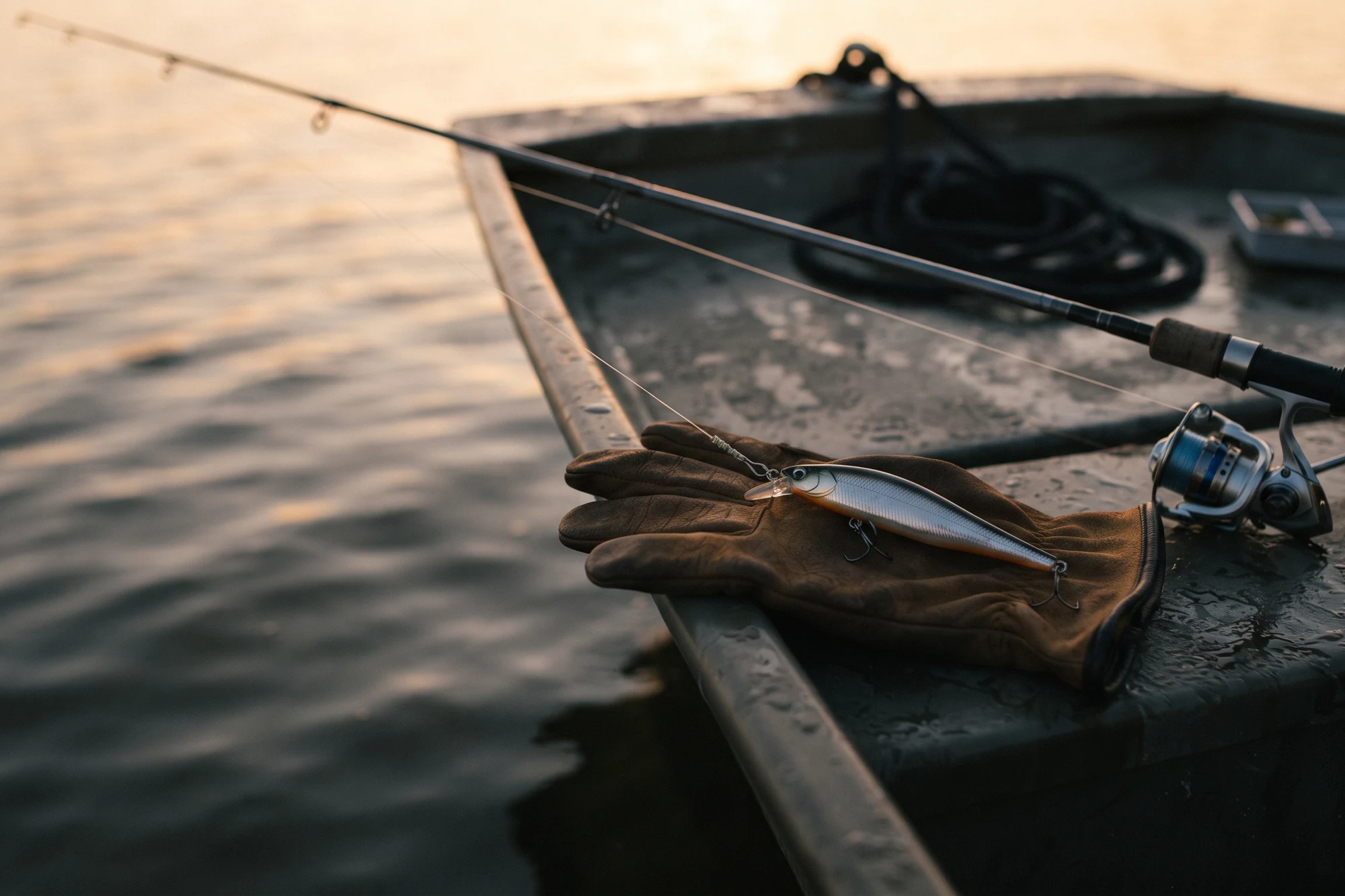
You just bought a jerkbait. The box says "Vision 110 Jr." or "Pointer 100SP" or "Suspending Rogue." There is a letter, sometimes two, after the model name, and the listing page did not explain what it means. This guide explains it.
The short version: F, SP, and S tell you what the bait does during the pause. The pause is when fish bite. The buoyancy rating determines whether the bait is still there when they do.
F means the bait leaves every time you pause.
A floating jerkbait has positive buoyancy. You jerk it down and it dives. You stop, and it slowly rises back toward the surface. Every single time.
That is not always wrong. If you are fishing water two feet deep and the bass are looking up, a floating bait is exactly right: it stays in the surface zone during the pause instead of hanging below where fish can see it. The Heddon Zara Spook is the classic example: it floats on the surface and works it with a walk-the-dog twitch. Topwater floating baits are their own technique with their own applications.
The problem comes when an angler buys a floating jerkbait expecting subsurface suspending behavior. You jerk it down to four feet, let it pause, and it rises a foot and a half before the fish can commit. You are not fishing the column anymore. You are fishing the ceiling.
SP means the bait stays where you put it.
A suspending jerkbait has neutral buoyancy. At rest, it neither rises nor sinks. It hangs in the water column at whatever depth the last jerk left it.
This is the feature that makes a jerkbait a jerkbait. The cadence is jerk-jerk-pause, and the pause is where fish eat. Read Jerking 101 if you want the full breakdown of cadence, but the short version is: the jerk is noise, the pause is the invitation, and the fish commits during the pause. If the bait has floated eight inches out of the strike zone while the fish was deciding, you just handed it an exit.
An SP bait keeps the hook in front of the fish's face for the full length of the pause. That is the entire case for neutral buoyancy.
Almost every serious suspending jerkbait carries this designation. The Megabass Vision 110 Jr. suspends. The Lucky Craft Pointer 100SP, the SP is literally in the name. The Jackall Rerange 110SP same thing. The Smithwick Suspending Rogue says it in the full product name. These baits suspend because the technique requires it and the manufacturers know it.
S means the bait keeps falling.
A sinking jerkbait has negative buoyancy. During the pause, it descends.
This is not a flaw. It is a design choice for specific situations. When fish are holding at ten to fifteen feet in July heat, a jerkbait that continues falling during the pause drives the bait down into the column where the fish actually are, instead of keeping it at the shallower depth of the retrieve. The Bill Lewis Rat-L-Trap and the Strike King Red Eye Shad are both sinking lipless rattlebaits, and you rip them up through the water column and let them fall back down. The S behavior is the entire technique.
The retrieve changes with a sinking bait. Shorter pauses or you lose depth control and the bait drops below the fish. It also makes line-watching more important: the strike often comes on the fall, and you will not feel it until the line does something odd.
The temperature problem every SP bait has.
A suspending jerkbait is calibrated to neutral buoyancy at a specific water temperature. Most manufacturers target somewhere around 55–65°F. Below that range the bait may sink slightly. Above it the bait slowly rises.
Here is the physics: water density changes with temperature. Cold water is denser than warm water. A lure calibrated to neutral buoyancy in 42°F water, where it displaces exactly its own weight in water, is now too light for 78°F water, which is less dense. It floats.
In practice: take the same SP jerkbait to a lake in March with 42°F water and it will suspend correctly. Fish it in August when the water is 78°F and it will slowly rise during the pause. Same lure. Same label. Different season, different behavior.
This matters most on long pauses. A cold-water bass in February needs a 10-to-15-second pause. That gives a warm-season bait time to float several inches out of position. A warm-water bass in July hits faster, but the bait is also already fighting its buoyancy. Testing your specific bait in specific water temperatures tells you more than the manufacturer rating. See the section below on the bucket test.
The fix options:
- Suspend dots: Self-adhesive lead strips that peel and stick to the belly or hook hanger of the bait. A single half-inch dot usually converts a summer-rising SP into a true neutral. Buy a pack, test in a bucket, adjust until the bait hangs still.
- Lead tape: Thin lead tape wound around a hook hanger a half-turn or full turn. More precise than dots for fine-tuning.
- Heavier hooks: Owner ST-36 or VMC 1X round-bend trebles one size up from stock add a few tenths of a gram and sink the bait slightly. The tradeoff: heavier hooks also change how the bait swims and may require re-testing. Cover this in more detail in cold-water jerkbait tuning.
- S-rated version: Some manufacturers make a slow-sinking variant of the same body for summer use. Slightly more expensive, requires no tuning, true neutral at warm-water temperatures.
The bucket test you should run before you fish.
Fill a five-gallon bucket with water from the lake or at roughly the same temperature as the lake you are about to fish. Add your bait. Watch what it does.
- Slowly rises: slightly buoyant. Add a suspend dot to the belly. Retest.
- Slowly sinks: slightly negative buoyancy. Usually fine: the bait hangs just below its retrieve depth during the pause. Fish it.
- Holds still: true neutral. You are done.
Three minutes of testing beats guessing about why the bite stopped.
What to buy if you are only buying one.
Buy SP.
It covers the most situations. The pause is where jerkbait fish commit, and you need the bait in the strike zone when they do. Floating baits leave on every pause. Sinking baits work, but they require more active depth management and a faster cadence, not ideal when you are still learning why the pause matters at all.
For cold water under 55°F: SP is the answer. The Rapala Husky Jerk 12 is cheap, widely available, and truly suspends in cold water. Buy two, you will lose one. The Smithwick Suspending Rogue is the other cold-water staple; it runs slightly deeper and handles walleye as well as bass.
For warm water over 65°F: your SP bait will probably rise on long pauses. Add a suspend dot, or shorten your pauses and fish a more aggressive cadence. Switching to an S-rated bait or a slow-sinking variant is the cleaner solution if the water is genuinely warm and the fish are holding deep.
Floating: buy one only when you are specifically targeting fish in the top two feet of water with a topwater presentation. Otherwise the rising behavior during the pause is the same problem a floating subsurface bait has, just slower.
The bait you just bought with SP in the name is the right bait. The only remaining question is whether you need to tune it for the water temperature you are fishing, and now you know how to find out.
If you are still putting together your first setup, How to Start Jerking covers the full day-one loadout: rod, reel, and the three baits that between them handle every situation you will run into your first season.