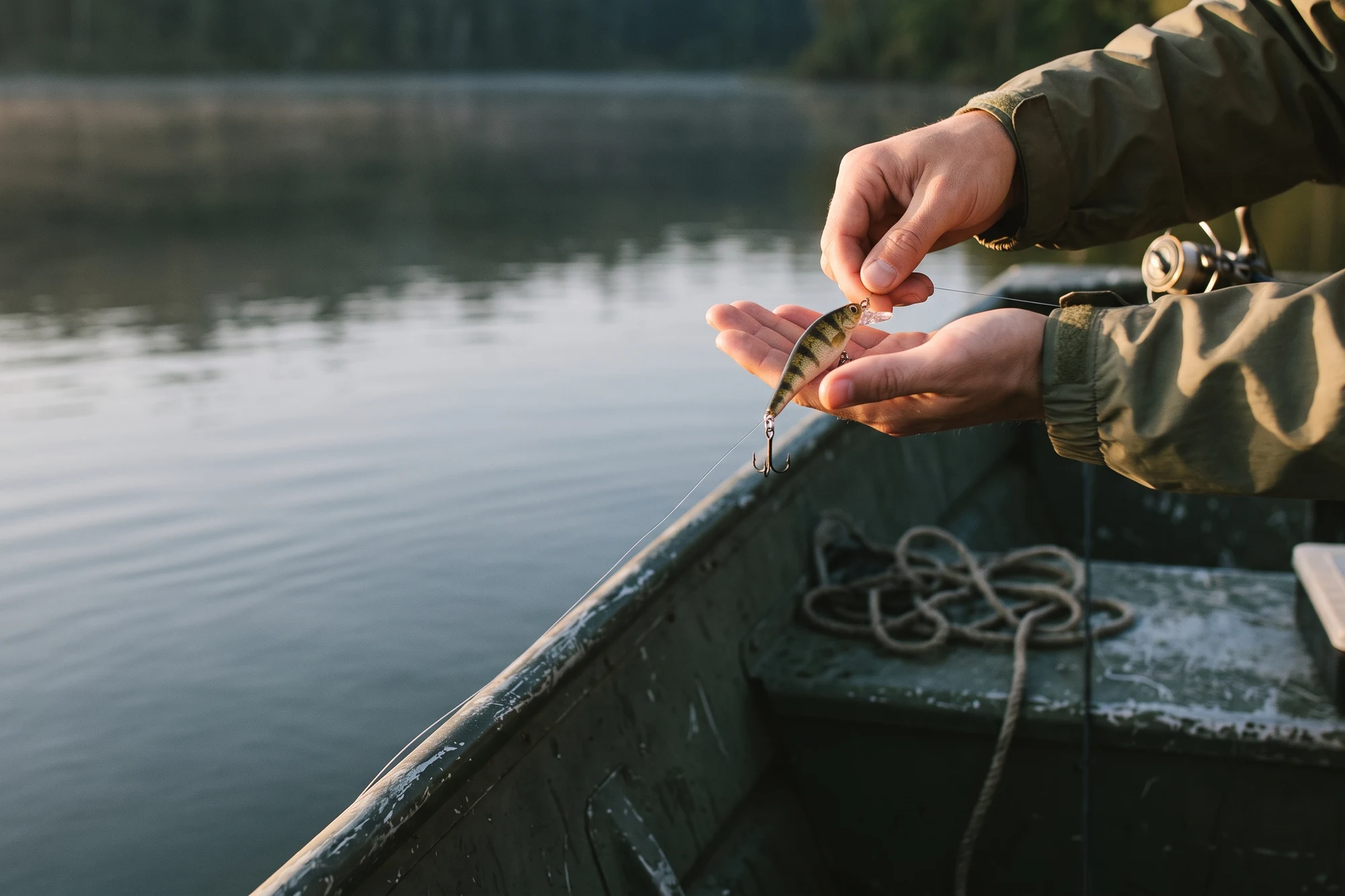
The phrase "search bait" earns a jerkbait more credit than it deserves, and misapplied that credit costs anglers fish. A jerkbait covers water faster than a Carolina rig and pulls reaction strikes from fish that are not actively feeding. It is also a lure that requires clear enough water to be seen, a specific depth window to work correctly, and a fish positioned where the retrieve can actually reach it. These are not minor qualifications.
The beginner who casts at every stump along 200 yards of bank will occasionally connect. The angler who casts at four specific spots on that same bank and ignores the rest will catch more fish, understand why, and repeat it on a different lake next weekend. This guide gives you the framework for choosing those four spots before the first cast leaves the rod.
The depth window that defines your water
A standard hard jerkbait on 8- to 12-pound fluorocarbon runs at 3 to 5 feet during the retrieve. A longer-bill version like the Lucky Craft Pointer 100SP reaches 6 to 8 feet. Shallower than 3 feet and the bait is too close to the surface; fish feel exposed at that depth in clear water and the geometry of a dart-and-pause presentation does not serve them. Deeper than 8 feet and you are asking a jerkbait to compete with blade baits and jigs in a zone where those tools are better suited to the job.
This defines your water before you make any other judgment. Does this spot have 3 to 8 feet of water where the bait will run? If no, move. No amount of cadence adjustment recovers from casting at the wrong depth.
The five windows that produce
Not every bank holds all five of these features. On a given session you are looking for any of them, and you are skipping everything that does not qualify.
Points. A point is where a shoreline juts into open water, typically dropping from 2 feet on the shallows to 6 or 8 feet at the tip. Bass use points as travel routes between deep and shallow water and as staging areas before moving to feed. The tip of the point, where the drop begins, is the starting cast. Work the deepest edge of the point first, then the shallow flat off each side. If the point has a stump or secondary hump at the tip, treat it as a priority.
Creek-channel transitions. Reservoirs are built over drainages, and submerged creek channels run beneath the main lake. Where a creek channel swings close to the bank and creates a depth change of 4 to 8 feet across a short lateral distance, bass stage along the channel edge before and after moving shallow. On a depth map, these show as a contour bend near the bank. On the water, they often show as a subtle color change or a soft mud bottom giving way to harder substrate. Work the jerkbait parallel to the channel edge, not straight at the bank.
Depth breaks. A flat that steps suddenly from 2 feet to 6 feet is a depth break. This differs from a point: there is no lateral feature jutting into open water, just a shelf in the bottom. Bass sit below the break looking up, or hold on the edge and slide up to feed. The Rapala Husky Jerk 12 at 3 to 4 feet is running directly above these fish during the pause. Work the break from both directions, and keep the pause positioned over the shelf edge rather than in the shallows above it.
Edges. Three kinds of edges hold jerkbait fish reliably: dock shadows, weed edges, and drop-offs. A dock creates shade that breaks up the visual field and lets fish hold shallow in clear water without feeling exposed. Cast parallel to the dock and keep the bait in the shadow for as much of the retrieve as possible. A weed edge, where submerged vegetation ends and open water begins, is a feeding lane; work the bait along the edge and pause at the boundary, not over the vegetation where the hooks will grab. A drop-off off a bluff bank or clay wall is a vertical edge where fish suspend at mid-depth and move to the face to feed.
Visible baitfish. This overrides all of the above. If you can see shad or small baitfish dimpling the surface, being pushed, or rolling near a point or flat, active fish are working that area right now. Start there regardless of what the structure looks like. A jerkbait is an imitation of a wounded baitfish, and when the real version of that is happening in the water in front of you, the presentation is already correct. Go to the bait first, analyze the structure second.
Temperature changes every location decision
Two anglers on the same lake, fishing the same lure with the same technique, catch different fish in April at 48°F versus early June at 65°F. The difference is not cadence. It is location.
At 48°F, bass are either pre-spawn and staging or recovering from winter lethargy. They are cold, slow, and holding on deeper structure: channel edges, the outside bends of creek arms where the bottom is 6 to 10 feet, and the deeper base of points where staging fish can sit without committing to the shallows. Shallow weed edges are mostly irrelevant at this temperature because the shallow water has not warmed enough to hold active fish. Focus on creek-channel transitions and the deeper end of depth breaks.
The pause at this temperature should run 8 to 12 seconds. That is longer than feels natural. The fish are not going to chase; they need the bait in their face for an uncomfortable amount of time before they commit. This is covered in detail in cold-water jerkbait tactics, and if you want to understand why your SP bait may actually behave differently in cold water than in the summer, F, SP, S has the full explanation.
At 65°F, the picture shifts. Bass have moved shallow, either staging for spawn or recovering from it, and they are distributed across a broader range of depth. Weed edges become active as vegetation fills in. Dock shadows are relevant because fish are now shallow enough to use them as cover. Shallow points with 3 to 4 feet at the tip produce instead of just the deeper sections. The pause shortens: 3 to 5 seconds is often sufficient before moving the bait again.
At this temperature, check your SP bait in a bucket of lake water before the session starts. A bait calibrated to suspend at 55°F will slowly rise at 65°F during a long pause, lifting it above where the fish are sitting. One suspend dot on the belly usually fixes it. Three minutes of testing saves a morning of casting at fish who are watching the bait float away.
The common mistake at either temperature is returning to the same water that produced at the other. The angler who found fish on deep creek transitions in cold April water and goes back to those same spots in June will fish them mostly empty. The water changed. The fish moved. The starting spots have to move with them.
Reading a bank before you cast
Before the first cast of a session, the question is not "what color do I tie on." It is "what is in front of me and does any of it qualify."
Scan the bank for lateral changes: a point, a dock, a patch of vegetation, a color change in the water that suggests a depth transition. If the water is flat, uniform, and featureless for 50 yards in both directions, that stretch is not your starting water. It might hold fish, but it holds them randomly, and random fish require random casts to find. Move until you see structure.
If a map is available, use it. Reservoir contour maps and mapping apps show creek channels, depth breaks, and flat-to-structure transitions that are invisible from the surface. Three minutes with a map before the session gives you a short list of starting spots rather than 200 yards of undifferentiated bank.
Once you have identified a qualifying spot, give it 10 to 15 casts across different angles before making a decision. Not 30 casts. Not 50. A jerkbait is a reaction bait. If fish are present and positioned correctly, a well-executed retrieve will produce a strike or a follow within the first few casts. Silence after 15 clean casts usually means the fish are not there or not positioned for it. Move to the next qualifying spot rather than adding more casts to the same empty water.
What to skip
Uniform banks with no depth break and no structural reference. Deep main-lake water over 10 feet where a standard jerkbait cannot reach the fish without specialized gear. Heavily stained water where clarity drops below 18 inches, which is a separate problem covered in stained water and the jerkbait. Open water with no bottom reference where fish have no reason to hold a specific position.
A search bait searches efficiently. Efficient means skipping the water that does not qualify and putting your casts on the water that does. The angler who understands this gets more fish per cast. The angler who fishes everything gets more casts per fish. On a slow day those two approaches feel similar. Over a full season they are not.
If you are still building the foundation for this technique, How to Start Jerking covers the gear side: the rod, reel, and three-bait loadout that handles every situation you will encounter in your first season. Location is the third piece. Now you have all three.