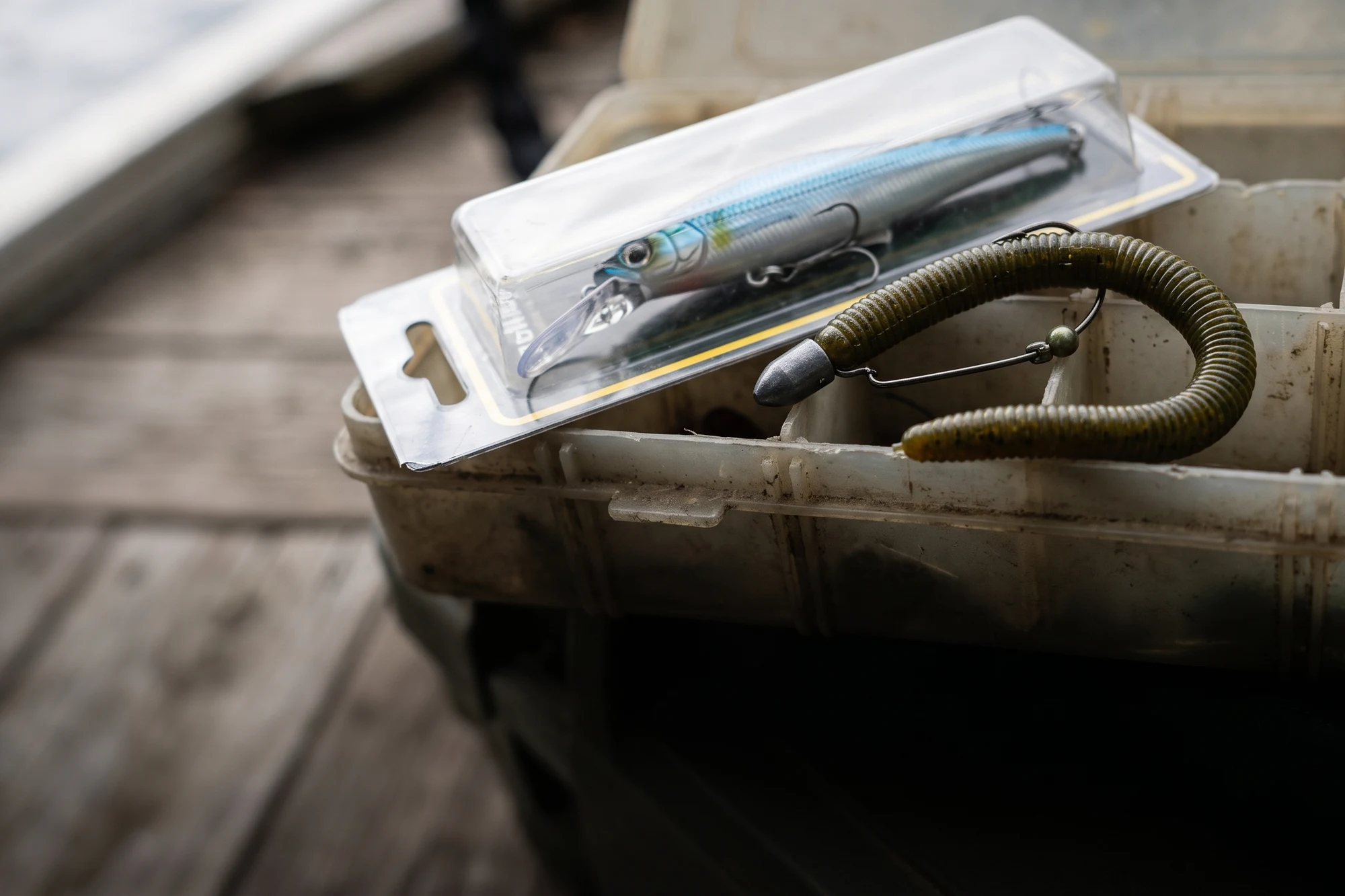
The Rapala Husky Jerk on a 10-second pause caught you fish last March. You have read the cold-water jerkbait guide, you know about slowing the cadence down, and you are standing on a boat in 43-degree water wondering why nothing is happening.
Here is the reason: 43 degrees is not cold-water jerkbait territory. It is not-jerkbait territory. The pause is not the problem. The bait is.
The biology: why 45°F is a different problem
Bass are ectotherms. Their body temperature equals the water temperature, and their metabolic rate — the speed at which they digest food, process energy, and fire muscles — drops in direct proportion to the water cooling around them.
At 65°F, a bass can intercept a moving lure, digest a full meal, and be hungry again by the next morning. At 43°F, the same fish may still be processing something it ate three days ago. It is not being difficult. It is not lockjaw. Its digestive system is running at a fraction of its summer pace, and its appetite has adjusted accordingly.
At that metabolic rate, a bass does not need to eat. It will eat if something edible presents itself close enough, slowly enough, that the energy required to take it is less than the energy it provides. But it will not chase. It will not track. The predatory reflex that fires in 300 milliseconds at 70°F takes several seconds at 43°F — long enough for a passing jerkbait to be gone before the fish has finished deciding whether it was interested.
Below 45°F is a physiological threshold, not a metaphorical one.
Why the jerkbait fails even with patience
A suspending jerkbait is a reaction-strike tool. The entire design — the dart, the pause, the flutter on a slow rise — is built to trigger an aggressive response faster than a fish can think about it. Buoyancy type matters, cadence matters, pause length matters. But all of that assumes a bass capable of reacting.
Even on a 10-second pause, a jerkbait is still something a fish has to track horizontally across a strike zone. It arrived at that pause position by moving through the water. The fish has to anticipate where it will move next and commit to an interception. At 43°F, that cognitive and muscular sequence is not available at the speed the technique requires.
Extending the pause to 20 seconds, 30 seconds, or longer helps — there are days in February where a dedicated angler will grind fish on a jerkbait with 45-second pauses. But that is a narrow window, a specific set of conditions, and an exhausting way to fish. The honest answer is that the jerkbait is doing most of the work and the fish are barely cooperating. Below 45°F, there are presentations that are not fighting the biology.
Blade bait on a lift-and-drop
A blade bait — the thin-metal flutter-spoon style of lure with a tight shimmy on the fall — is the most underused cold-water freshwater bass weapon most anglers own nothing resembling. The reason it works below 45°F is simple: it falls nearly straight down. A stationary bass does not have to track it across a strike zone. The bait descends into its face and stops.
The technique: drop to bottom, lift 8-12 inches, let it fall back on a semi-slack line. Pause on the bottom for 5-10 seconds. Lift again. The fall triggers the interest; the pause is where the bite happens — usually a thump as the bait sits. Fish it on 8-10 lb fluorocarbon from a medium-light rod with a sensitive tip. A 1/4 to 3/8 oz blade in chrome or gold is the right weight for most lake depths under 20 feet. Nothing in the product registry here maps cleanly to this category — the spoons are casting spoons that fish differently — but any tackle shop will carry something labeled blade bait or jigging blade that does the job.
This is vertical or near-vertical fishing. Get directly above the fish, or close to it.
Finesse jig dragged at a crawl
A 3/16 to 1/4 oz finesse jig or Ned rig with a small soft-plastic trailer is the workhorse cold-water bottom presentation for bass that have no interest in anything moving at a reasonable pace. The premise: the fish will not accelerate to catch a moving lure, so the lure has to be available where the fish already is.
The Z-Man TRD TubeZ rigged on a 1/16 to 1/8 oz finesse jighead is a strong cold-water combination — the tube profile kicks slightly on the drag, then dies on the pause. The Pautzke Fire Neds micro finesse jigs fish a similar presentation. Either works; the details of the retrieve matter more than the brand.
Technique: cast to structure, let the bait settle completely to the bottom, then drag it 8-12 inches along the bottom and stop. Wait five seconds. Then 10. Then 15 if nothing happened. Drag another 8 inches. Most cold-bass bites come during the pause, and they are soft — a slight weight on the line, a tick, sometimes just the line going sideways. Use 6-8 lb fluorocarbon on a medium-light spinning rod so you feel it.
The retrieve speed that seems absurdly slow on a warm October afternoon is still too fast at 43°F. If you are covering more than two feet of bottom per minute, slow down.
The shaky head: just park it
This is the most extreme version of the same argument. A 1/8 oz shaky head jig with a straight-tail finesse worm, cast to the target, rod tip barely moving — or completely still. The bait sits on the bottom. The bass eventually commits.
The Yamamoto Senko 5" on a 1/8 oz round jighead is a legitimate stationary cold-water rig. The subtle movement from the worm's own weight and salt content, fished without any rod input, is often enough. At 43°F you may wait 20-30 seconds between the bait landing and a fish picking it up — and you will feel the urge to twitch it well before that window expires.
Do not twitch it. Park the bait, count slowly, and only move it after you have counted to 20 at least once. Then drag it 6 inches and start the count again. The key discipline is leaving it alone long enough for a cold, slow fish to decide it is safe to eat.
Temperature is the variable, not the technique
Below 45°F, a longer pause will not rescue a jerkbait. The jerkbait is architecturally the wrong tool for the conditions — not improperly executed. Reaching for a blade bait, a finesse jig, or a stationary shaky head is not conceding the day. It is fishing the water that is actually in front of you.
The jerkbait earns its place from about 48°F upward — that is its window, and it is productive enough that most anglers overextend it into temperatures where it stops working. Check the thermometer. When it reads below 45, put the suspending minnow away and go vertical. The bass are on the bottom, moving slowly, and entirely willing to eat something that costs them almost nothing to take.