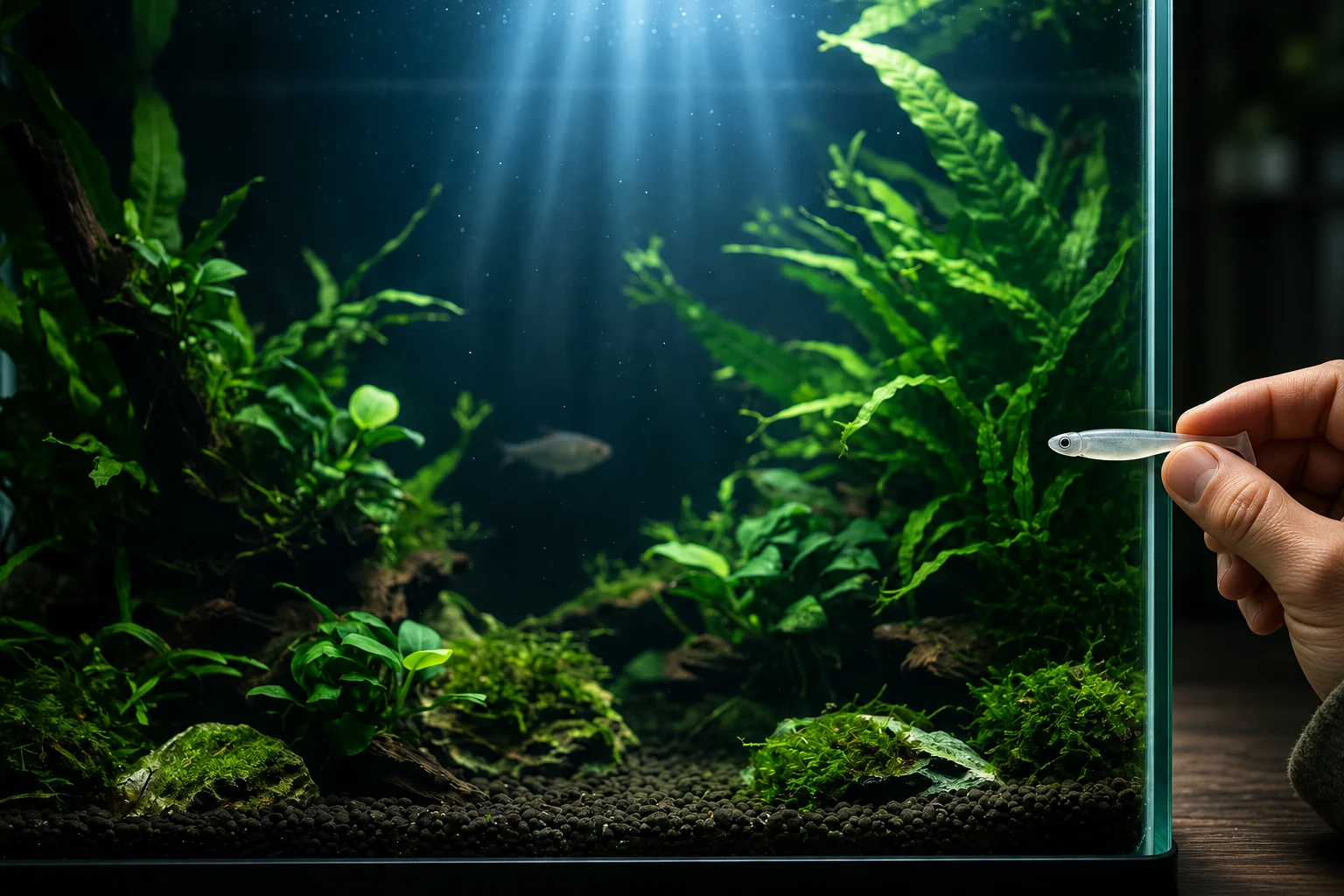
Aqueon's published dimensions for a 20-gallon long are 30¼ inches long, 12½ inches wide, and 12¾ inches high. Those are exterior tank dimensions, not a promise of clear swimming space. Allow an illustrative three inches at each end of the long side and you have about 24 inches to mark on the outside of the glass. That is our rehearsal window. The lure stays outside the tank, with hooks removed.
The math on the glass
Put two removable markers 24 inches apart beside the long pane. A rod snap does not move every lure a fixed number of inches. Line slack, rod movement, lure action, and reel size all change the result. Make a slow, hookless hand rehearsal alongside the markers and watch how much distance each motion uses. Do not run a rod tip or lure against the glass.
One full handle turn can take up much of this short window, depending on the reel and how full its spool is. Read your reel's line-retrieve specification if you want a starting number, then check the actual movement in the rehearsal. A gear ratio alone does not tell you inches of line per turn.
The point shows up before the second snap: at this scale, a casual crank can use the space you meant to reserve for a stop.
Why shortening the pause misses the point
It is tempting to shorten the pause because the marked window is short. Distance and time do different jobs. The snap moves the bait; the pause lets it sit. Cutting the pause does not give the bait more room.
In open-water jerkbait fishing, the snap makes the bait dart and the pause gives a following fish a chance to inspect it. There is no universal two-second minimum. Pause length depends on conditions and on what the fish do. For this demonstration, choose a visible two-count so you can tell a deliberate stop from continuous twitching. The pause guide covers the on-water technique.
The tank's listed height is also an exterior measurement. Water depth changes with the fill line and substrate, so calling it a 12-inch water column would be false precision. Besides, a suspending bait's running depth and buoyancy depend on the particular lure and rig. None of that needs testing in a stocked aquarium to understand the cadence.
A smaller lure can make the scale comparison easier to see, though it cannot create more length. The tank sizing guide shows the lure-to-tank ratio. Its suggested size is a display proportion, not a rule for putting tackle among aquarium fish.
Keep the pause in the rehearsal
Hold the hookless lure beside the glass, outside the water. Make one short hand motion, stop completely for a two-count, then make the next motion. The two-count is a teaching cue, not a claim about aquarium fish or the right pause at a given temperature.
With the whole window visible, you can see whether the second motion leaves any room for another stop. A pause takes time, not travel; the trouble is the distance used before it.
No hooks or lures go into an occupied tank for this exercise. The Aquarium Jerk Log describes its six-week handling and cadence rehearsal outside the glass, with no water contact.
Use the long side and reset
Mark the long side, then treat the second marker as a reset point. This is a visual rehearsal of the cadence, not a retrieve through the tank.
Start at the first marker with a hookless lure in hand, outside the pane. Make one short motion and pause for a two-count. Move to the next position in the marked window, pause again, and reset when you reach the far marker. If you want to rehearse the opposite direction, turn your hand and repeat. There is no need to claim that a rod snap travels six or eight inches, or that a lure can reverse itself at a wall.
The reset preserves what you came to practice: move, stop, wait. A wall is a useful visual limit. It is a poor target for a treble hook.
The practical rules for this tank-side rehearsal:
- Use the long side as the reference and mark your own clear window.
- Rehearse one motion at a time and watch the distance it uses.
- Stop deliberately before the next motion.
- Keep the lure and hooks out of the water and away from the glass.
What the short window teaches
The usual open-water retrieve does not fit neatly into a marked 24-inch window. That is the joke, and the useful lesson: measure the line you recover, leave space for the bait to move, and give the stop its own beat. On a lake you get to cast again. Beside a tank you reset your hand.
For the broader scale bit, see Jerking the 20-Gallon. For actual small-water tackle, the Little Jerks finesse lineup covers baits meant for fishable water.
The 24 inches are a chosen demonstration window, with three inches set aside at each end of a roughly 30-inch tank. Mark yours on the outside. Leave the residents out of the lesson.