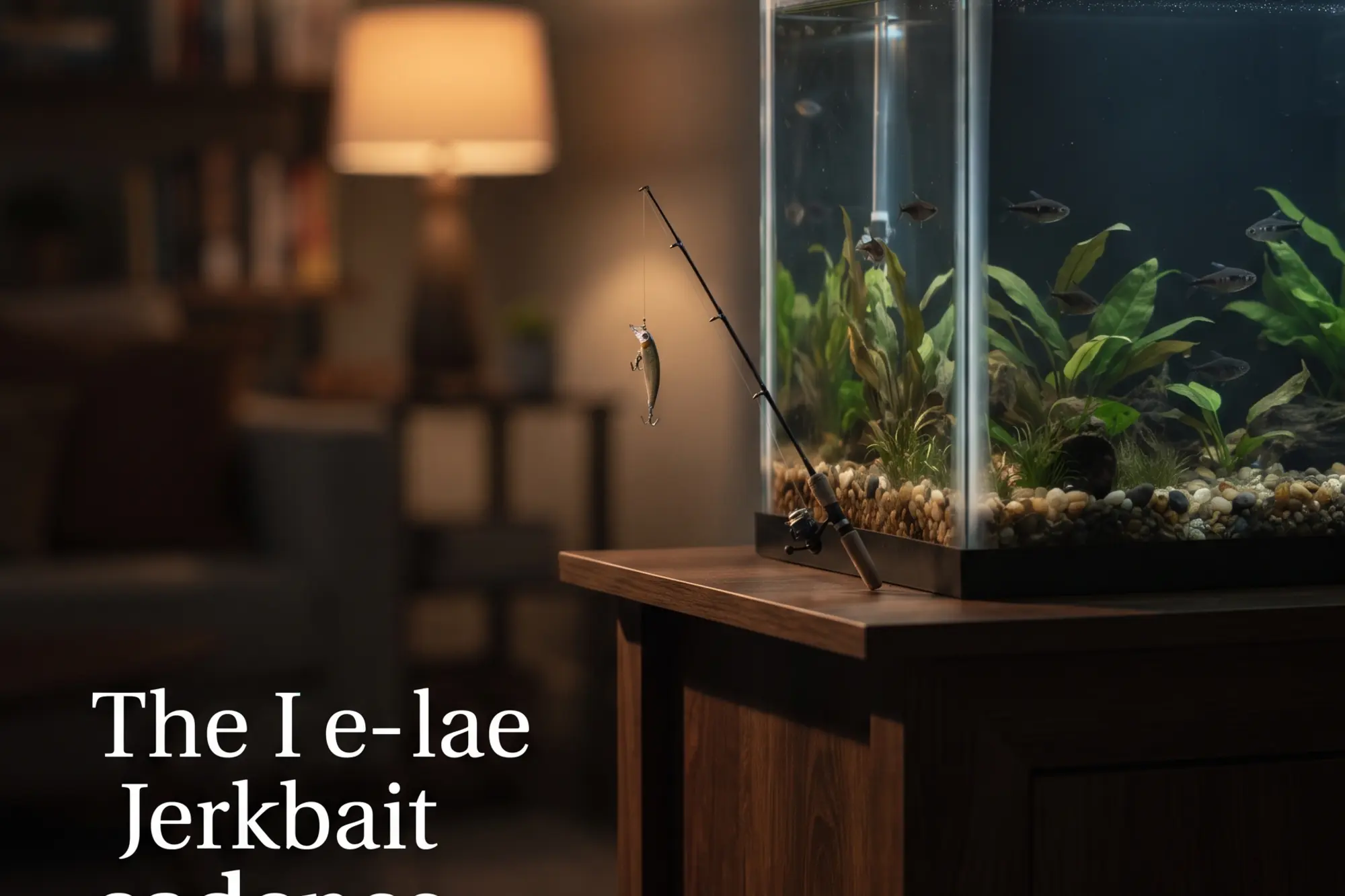
We are aware of how this looks. A twenty-gallon tank is not a lake. It is not a pond, a river, or a boat ramp with a bait shop attached. It is a glass box on a stand in your living room, and the "fish" in it have names. None of that changes the fact that jerkbait technique is technique, and technique scales down a lot further than most anglers assume before it stops working. This is a straight technique breakdown for fishing a jerkbait at aquarium scale: gear, cadence, the whole thing, treated with exactly as much seriousness as we'd give a guide to a hundred-acre reservoir. We're not going to wink at you through the whole article. We're going to tell you how to do it right.
Why scale is the entire problem
Every jerkbait technique guide on this site starts from the same premise: match the lure to the water and the fish will tell you if you got it wrong. A twenty-gallon tank is the most extreme scale-down of "the water" you'll ever fish, which means lure selection stops being a preference and becomes the whole ballgame. A four-inch jerkbait that reads as normal-sized in six feet of lake water reads as an invasive species in eighteen inches of aquarium. You need lures built for finesse water (small, light, and precise) or you are not doing this technique, you're just dropping a chunk of plastic into a fish tank.
The good news is finesse-scale jerkbaits already exist for a reason that has nothing to do with aquariums: panfish, small stream trout, and pressured bass in gin-clear water all demand the same downsized, subtle presentation. A tank just happens to be the most literal version of that problem. The gear that works small on a stream works small here too.
The three-lure loadout
A Rapala X-Rap 04 is the anchor bait. It's a two-inch finesse darter designed for exactly the kind of tight, precise side-to-side movement that a confined space rewards. In open water it's built for crappie and perch, which tells you everything about the scale of fish it was engineered to convince. In an aquarium, that same tight darting action is the difference between a lure that looks like it belongs and one that looks like a toy on a string.
A Z-Man TRD TubeZ covers the soft-plastic side of the loadout. It's a Ned rig in miniature: small profile, subtle fall, built to look like something worth investigating rather than something worth fleeing. On light line at aquarium scale, the slow settle of a Ned-style tube is about as unthreatening a presentation as this technique has.
A Bassdash SwimPanfish rounds it out as the swimbait option, a multi-jointed 2.5-inch profile that moves with a natural swimming gait instead of a dead-straight retrieve. It's the closest thing on this list to matching what's already living in the tank, which makes it the bait you reach for when you want the most realistic presentation the scale allows.
Cadence, at a scale you can actually see
Standard jerkbait cadence (jerk, jerk, pause, repeat) is built around giving a suspended lure time to sit still and look wounded before you move it again. That principle doesn't change just because your "water" is bounded by silicone seals. If anything, a twenty-gallon tank is the best classroom you'll ever have for learning to read a pause, because you can watch the whole thing happen in real time from eighteen inches away instead of guessing what's happening forty feet down a stained lake.
- Short, sharp wrist snaps, not long sweeping rod pulls. There's no room in a twenty-gallon footprint for a technique built around covering water; this is about precision in a fixed space.
- Pause longer than feels natural. In open water a two-second pause is aggressive. At this scale, even a half-second of stillness reads as a much bigger event to anything watching it happen three inches away.
- Watch the roll, not just the direction. A suspending bait that's balanced correctly will show you a clean side roll on the pause, the same tell a bass angler is watching for on a twelve-foot ledge, just magnified to where you can actually see it.
Why the technique still holds up
Strip the bit away and what's left is a genuinely useful lesson: jerkbait fishing is about reading a pause and matching lure scale to the water in front of you, and both of those principles are scale-invariant. A twenty-gallon tank just happens to be the smallest, most controlled environment you could possibly run that lesson in. If you've ever struggled to visualize what a "clean side roll" or "a longer pause than feels natural" actually looks like from a boat, this is as close as you'll get to seeing it from three inches away, gear in hand, hooks nowhere near the water.