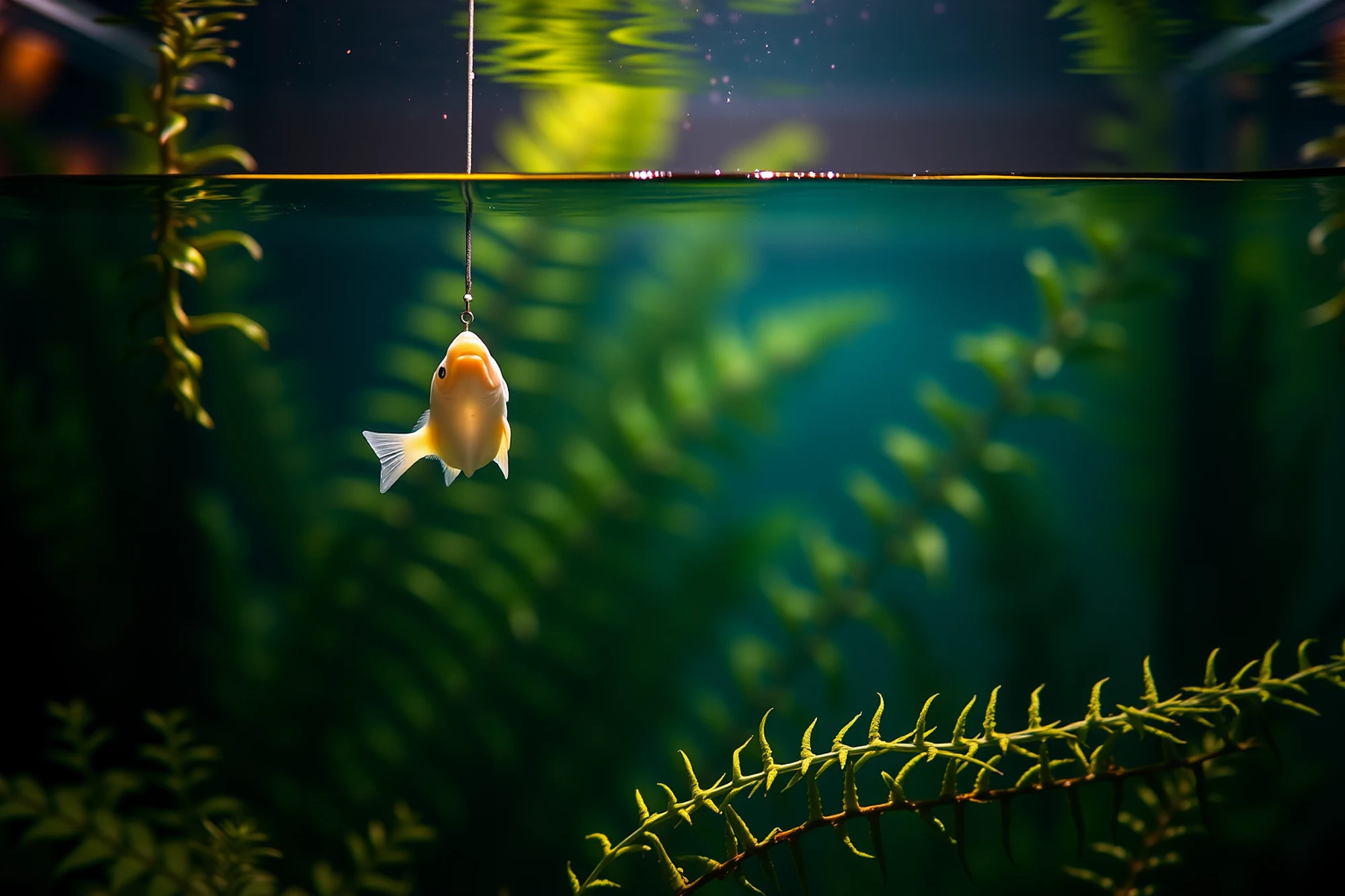
A 20-gallon long tank measures 30 inches in length. A standard 4-inch hard jerkbait is 4 inches long. That is 13 percent of the available water column — a number that sounds theoretical until you hold the lure up next to the glass and see, clearly, that it is wrong. This is not a style preference. It is a proportionality problem, and it has a correct answer.
The math, stated plainly
To understand why this matters, scale it up. A 14-foot aluminum johnboat measures 168 inches. Thirteen percent of 168 inches is 22 inches. A 22-inch swimbait. In a 14-foot johnboat. If you watched someone unpack a 22-inch swimbait on a 14-foot jon boat and announce they were going to jerk it, you would move to the other side of the launch ramp.
The tank angler deploying a 4-inch jerkbait in a 30-inch tank has made the same error. The proportions are identical. The physics are indifferent to scale.
The target ratio for a 20-gallon long is under 7 percent of tank length. That puts the upper ceiling at 2.1 inches. A 2-inch lure fits. A 4-inch lure does not, regardless of how well it is tuned or what the action was designed to do. This is not a debate.
The approved shortlist
At exactly 2 inches, the Rapala X-Rap 04 sits at the upper edge of the acceptable range. It is a finesse darter engineered for crappie and perch — fish that occupy the same scale neighborhood as the typical community tank resident — and that design origin produces the tight, contained side-to-side action a 30-inch space rewards. There is no excess travel on the dart. The lure moves without demanding room it does not have.
The Rapala Ultra Light Minnow in the 1.5-inch variant brings the ratio down to 5 percent, which is the more conservative and arguably more disciplined choice. At 1.5 inches it is also the closest in silhouette to the fish that typically occupy a community tank, which matters less for technique and more for the overall internal logic of the presentation.
The smaller Yo-Zuri Crystal Minnow — the 1.5-inch version, not the 2-inch, and specifically not the larger inshore models that have no reasonable connection to a glass box — offers a holographic flank that reads extremely well under LED tank lighting. That finish was an engineering decision made for saltwater clarity, and the continuous LED strip replicates those conditions better than most freshwater environments do. Whether this constitutes a meaningful advantage is, at present, unclear. The fish have not indicated a preference.
Custom-painted bantam lures in the 1.5-to-2-inch range also clear the proportional threshold. The paint choice matters less than the profile. A correctly sized lure in a flat finish is preferable to a badly proportioned lure with an excellent paint job.
Verifying clearance before committing
Before any lure enters the rotation, strip the treble hooks and rig it on a hookless test assembly. A bare split ring at the nose hanger is sufficient. Do not skip this step.
With the hookless lure held at mid-water column and centered horizontally:
- Confirm at least 3 to 4 inches of clearance on each lateral side at the widest arc of the dart path.
- Verify that at the lowest point of a realistic pause, the lure tail does not contact the substrate.
- Check that at the upward phase of the retrieve, the nose does not break the surface.
A lure that clears all three conditions has earned its place in the loadout. One that fails on any point goes back to the shelf regardless of its proportional credentials. Scale math identifies the correct class of bait. Clearance testing identifies the specific unit.
Line weight for indoor water
The substrate shadow problem is real and specific to indoor water. Natural-bottom lakes scatter ambient light across a wide diffusion angle; monofilament in open water reads as effectively absent at most depths. A 20-gallon tank under a direct LED strip does not scatter light. It concentrates it downward onto a flat substrate.
Four-pound clear monofilament disappears cleanly in this environment. The small diameter and minimal surface interaction of clear mono makes it the right call here. It reads as absent both to the fish and to the observer watching from outside the glass, which is the outcome the presentation requires.
Braid is wrong here for a reason that is simple to verify: hold a short section of 6-pound braid — any color, clear included — in front of a lit tank. The woven surface structure casts a fine shadow onto the substrate below. Not a dramatic shadow. Subtle. But in 18 inches of water under direct LED illumination, a line shadow on the sand is a feature the fish can see, and it is a feature that was not part of the presentation you designed.
Fluorocarbon is near-invisible in water and casts no shadow, but coil memory at 2-to-4-pound test in a 30-inch working space creates presentation problems the mono does not have. The stiffness at light test weights affects the pause in ways that are visible from outside the glass. Use the mono.
Cadence and the current results
Standard jerkbait cadence applies at this scale: two short, crisp wrist snaps followed by a full 2-second pause. The pause is the event. Everything in jerkbait technique comes back to giving the lure time to hold still and look like something worth eating before moving it again. That principle does not change because the water is bounded by silicone seals and owned by someone who named the fish.
We have been running technically correct cadence in the 20-gallon for three sessions now. The Rapala X-Rap 04 is proportionally appropriate, the line is invisible, the clearance is confirmed, the cadence is calibrated. The fish are aware of the lure — there is eye contact, in the sense that fish can maintain eye contact, which is a structural feature of anatomy rather than a behavioral choice. What follows that eye contact has not, to date, been a strike.
The leading hypothesis is environmental conditioning. Fish fed at the surface at consistent intervals by a consistent hand at a consistent location develop strong priors about what constitutes a food event at that location and at that depth. A 2-inch finesse darter executing a jerk-jerk-pause sequence at mid-column does not match those priors. This is a variable we are working to isolate.
The secondary hypothesis — that the target species is simply not responsive to hard-bodied jerkbaits at this scale — we are not prepared to accept. Three sessions is not a trial. It is a sample size, and sample sizes are not verdicts.
For the full technique breakdown for the 20-gallon, including cadence mechanics and the three-lure loadout context, see Jerking the 20-Gallon. Six weeks of logged field notes from the same tank are in the Aquarium Jerk Log. The Little Jerks finesse lineup is where the proportionally correct baits live.