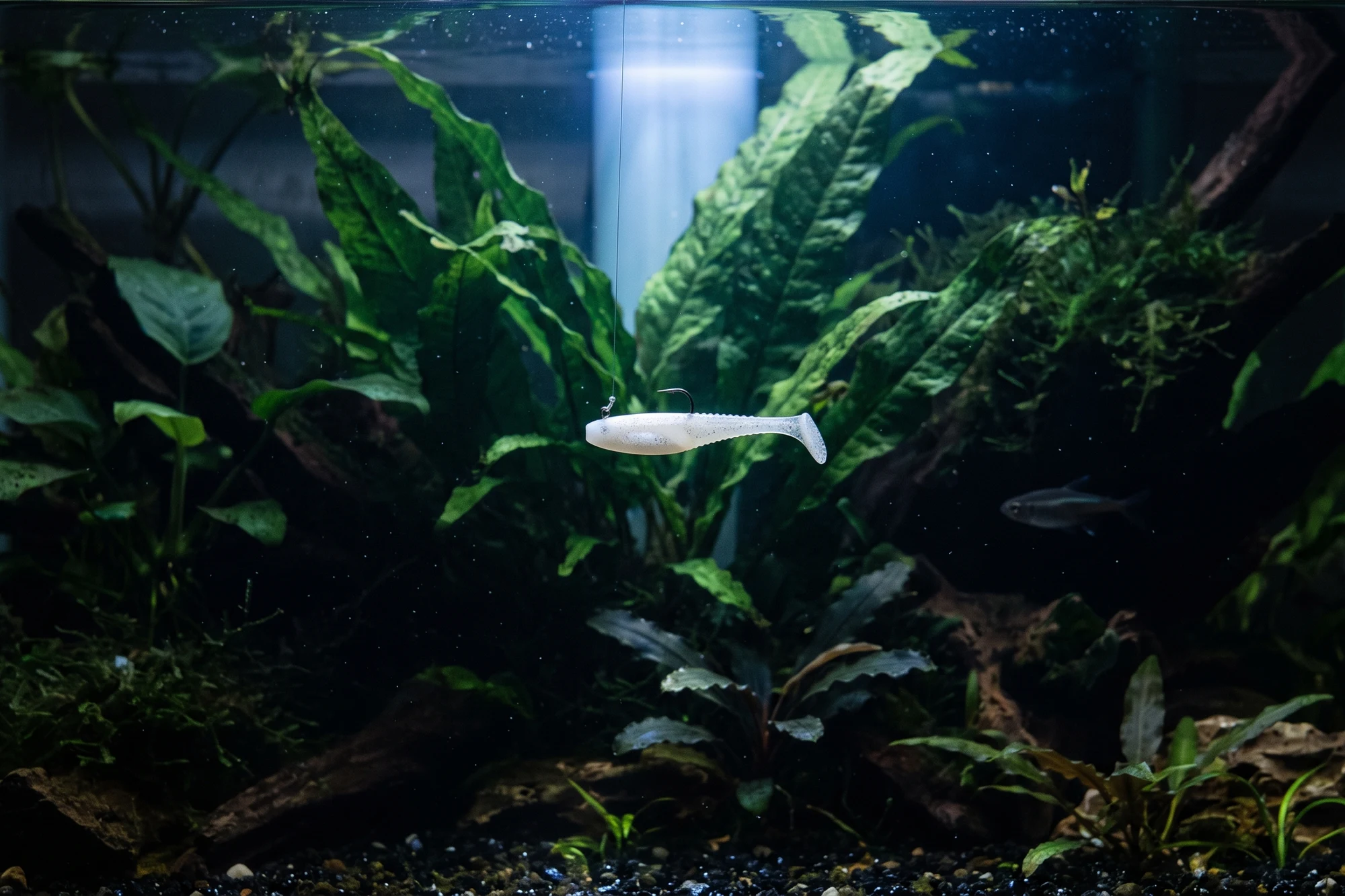
The question arrives at the point of purchase: chrome or natural shad. You are holding both packages. The chrome finish looks like it was machined from a solid billet of something expensive — it catches the store's fluorescent tubes from six feet away and throws light across the aisle. The natural shad looks like someone in a factory had to paint eight hundred of them by Friday. Chrome is obviously the right answer.
It is the wrong one. Not slightly wrong — structurally wrong, in a way that is entirely predictable if you understand the lighting environment you are actually shopping for. An aquarium is not an open lake under a June sky. The physics of how light behaves in that space are completely different from outdoor conditions, and a finish engineered to catch sunlight on the retrieve will fail the moment you hold it up to the glass.
Why the light source matters
A standard 20-gallon aquarium runs a full-spectrum LED strip rated somewhere between 6,500K and 10,000K — blue-white, daylight-equivalent or cooler. The strip sits directly above the tank. Power typically runs 20 to 40 watts. That is not a lot of light, and more importantly, it comes from one direction: overhead, nearly perpendicular to the water's surface.
When you hold a lure against the outside of the glass to evaluate it, you are almost certainly standing in front of the tank, looking horizontally through the glass. The light source is above. The lure surface is facing you. That geometry is the entire problem.
Specular versus diffuse: the short version
Two things can happen when light hits a surface. Specular reflection means the light bounces off at an angle equal to the angle it arrived at — like a mirror. For specular reflection to reach your eye, the light source, the surface, and your eye have to line up at the right angles. Diffuse reflection scatters incoming light in all directions regardless of angle. It does not care where the light source is. It works under any condition.
Chrome and metallic lure finishes are specular. They are vacuum-metallized — a thin aluminum or chrome layer deposited on the lure body under a vacuum. In open water, that metallized surface is hit by sunlight from multiple angles as the lure rotates on the retrieve, and some fraction of those angles is always favorable. The lure flashes. It looks alive.
At three inches from the glass, under a single overhead LED strip, the geometry almost never resolves. The light comes from above; the specular reflection goes sideways or back up; your eyes, positioned directly in front of the lure, collect almost none of it. The chrome finish that threw light across a tackle shop aisle simply sits there, flat, looking like a pale painted surface with zero depth.
What fails at the glass
Any finish that depends on a metallized outer layer is going to underperform. This includes:
- Chrome, silver, and mirror finishes — the classic specular offenders
- Foil-insert designs where a reflective sheet is laminated under a clear coat
- Holographic patterns that require direct, angled light to produce their color shift
- Any lure marketed with words like "flash," "blaze," or "chrome tiger" in the colorway name
These finishes are not bad lures. They are bad display lures. The conditions that make them effective — moving retrieve, variable sunlight angle, distance — are exactly the conditions an aquarium eliminates.
What holds up
Matte translucent patterns work because the color lives inside the bait body or in a matte pigment coat, not in a reflective surface layer. Light enters, scatters through the pigment, and diffusely exits in all directions. You see consistent color from any angle, under any light source, at any distance.
Printed scale texture creates dozens of small facets across the lure surface. Even without pigment depth, those facets scatter incoming light rather than reflecting it as one flat plane. Under close inspection under a tank LED, a printed scale pattern shows dimension and contrast that a smooth chrome side simply cannot produce.
Pearl and iridescent pigments are somewhere in between. They are slightly directional but far more diffuse than vacuum metallization. A natural shad pattern with pearl flanks reads consistently well under overhead LED because the pearl effect requires only that light hits the surface — not that it arrives from a specific angle.
The Rapala X-Rap 04 is a useful example. It comes in both chrome and natural-finish colorways. The chrome version looks exceptional in product photos taken under controlled studio lighting with the flash at the right angle. The natural-finish versions — ghost, baby bass, olive — use translucent body colors and printed scale detail that read consistently at three inches from the glass. The natural shad finish is, quietly, the correct aquarium choice every time someone selects the chrome version at the register.
Shopping for a display lure
When you are choosing a lure specifically for aquarium-side evaluation — which, in case it needs to be stated, is a completely legitimate use of jerkbait gear and should be treated as such — look for:
- Translucent or semi-translucent body color with internal pigment depth
- Visible scale printing or textured surface detail, not smooth mirror sides
- Matte or semi-gloss clear coat rather than a gloss chrome overcoat
- Colorway descriptions that reference natural baitfish: "shad," "alewife," "smelt," "ghost," "bone"
Avoid any finish whose marketing language leads with light and flash. Those finishes are built for a set of optical conditions that do not exist inside a glass box on a shelf.
The packaging irony
The upcharge chrome pattern exists on the peg because it photographs well. Product photography rigs a controlled directional flash at the exact angle that maximizes specular reflection — the lure blazes, the chrome sings, the listing photo justifies the extra dollar. Then you get it home, hold it up to the tank, and the finish that looked like molten silver looks like a matte grey primer coat under a 28-watt LED strip.
The utilitarian natural shad pattern in the same product line, which no one is photographing at controlled angles, reads exactly as well under the tank as it does in the water. Possibly better, because at three inches you can see the scale print detail and the translucent belly color without any retrieve blur obscuring it.
The correct finish was the boring one. It almost always is.
One more thing
This guide is about light physics and finish selection for display purposes. As with everything in the aquarium lane: no hooks, no water contact, lures evaluated outside the glass. The fish in your tank did not agree to participate in a study on specular reflection. Leave them out of it.