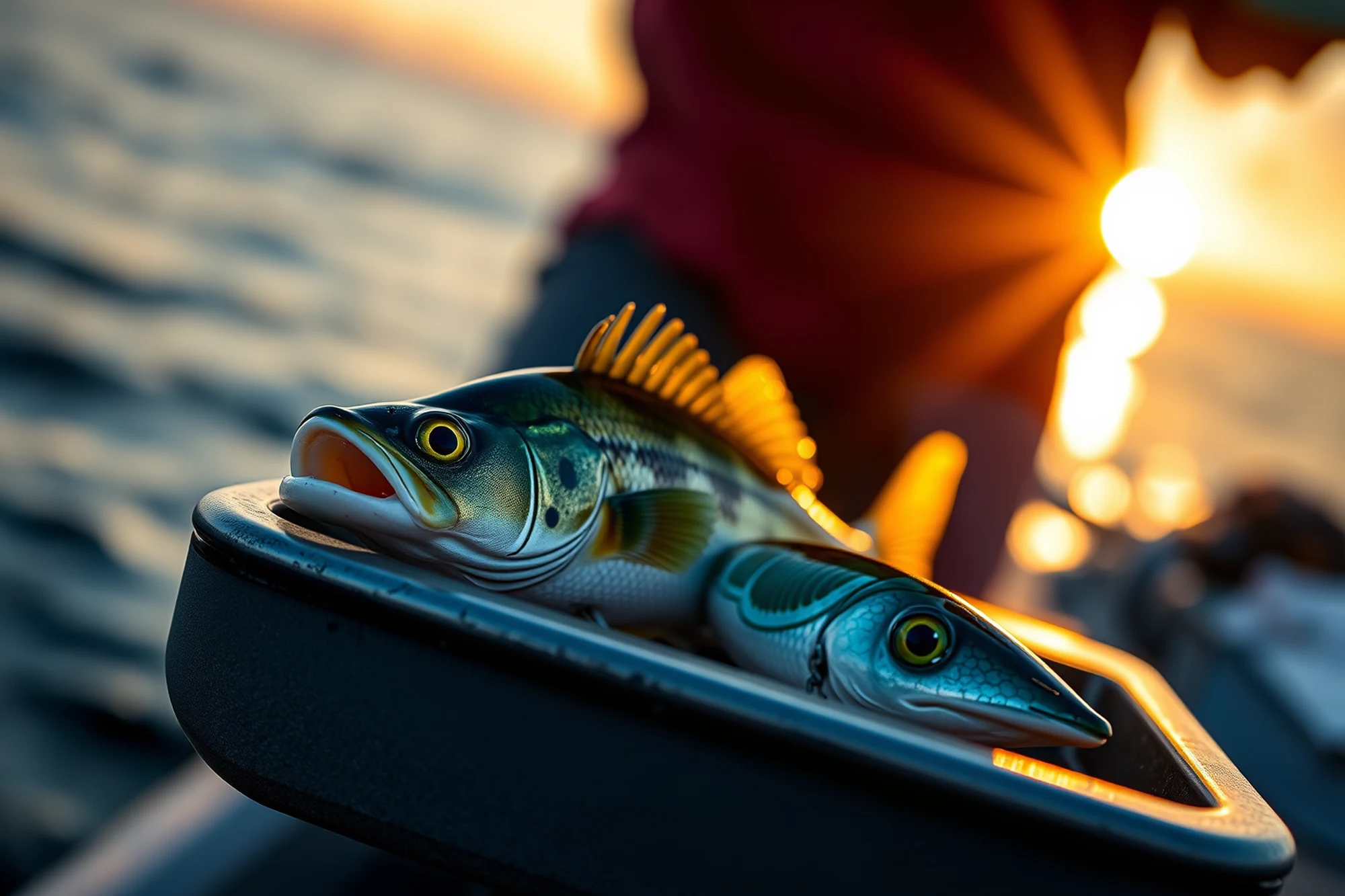
The honest reason your jerkbait caught nothing
The fish were there. The bait was moving. Nothing happened.
That is not a cadence problem or a wrong-color problem. That is a visibility problem. A jerkbait is a visual lure — it triggers strikes because a bass can see it from three to five feet away, decide it looks worth eating, turn, and intercept it before it moves out of range. That sequence requires a minimum of roughly twelve to eighteen inches of clean visibility. Post-rain, in water the color of weak coffee, you are often working with six inches or fewer. The sequence does not exist.
You are fishing a hard piece of plastic through a world the fish cannot see. It is the most expensive way to catch nothing on the lake.
How to actually check visibility before you waste time
Two field tests. Neither requires equipment.
The hand test: Submerge your hand to wrist depth, palm facing up. If you cannot see your palm, visibility is under twelve inches. That is the line.
The white lure test: Drop a white or pearl soft plastic vertically off the side of the boat and watch it. If it disappears before it hits eighteen inches of depth, you have your answer.
Both tests take fifteen seconds. Do one before you tie on anything. You will make better decisions with real information than with optimism.
What turbid water actually does to a jerkbait
Beyond raw visibility, stained water breaks every advantage a jerkbait carries and amplifies every disadvantage it has.
Flash becomes noise. In clear water, holographic and chrome finishes mimic reflected light off a baitfish. In stained water, that flash is scattered, unpredictable, and shows up at close range in ways that read as wrong rather than wounded. The bait does not look injured. It looks like a piece of hardware behaving strangely.
No scent. Hard plastic delivers zero. In turbid water, bass rely more heavily on their lateral line and their sense of smell to locate and commit to prey. A jerkbait gives them nothing to smell. Even at point-blank range, after the fish has tracked the pressure wave and caught a visual flash, there is no olfactory cue to close the sale.
The darting signature is wrong. Jerkbaits produce a tight, low-amplitude dart-and-glide. The lateral line signal from that movement is subtle — it is built for a fish that has already spotted the bait visually and is evaluating it up close. In dirty water, where fish are hunting by feel before they can see, that subtle signature reads as nothing worth chasing. Vibration sells in stained water. Darts do not.
The chartreuse argument — and where it breaks down
Some anglers fish chartreuse jerkbaits in stained water, and they catch fish. This is not wrong. Chartreuse and citrus finishes sit at a wavelength that penetrates turbid water better than chrome or natural patterns — longer wavelengths hold up further than short ones in suspended particles, and chartreuse is close to optimal on that curve.
The honest version of this argument: chartreuse extends the jerkbait's useful visibility threshold from about twelve inches to maybe twenty. That is real and worth knowing. When conditions are marginal — eighteen to thirty inches of visibility — a chartreuse or citrus bait is a legitimate first move.
Below twelve inches of visibility, color stops mattering. The fish cannot see the bait long enough for finish to register as an advantage. The chartreuse camp catches fish in marginal conditions and attributes it to the color. They are often fishing conditions where a jerkbait was already viable — they just optimized it. In genuinely bad water, the color does not save the technique.
What actually works
Lipless crankbaits. The Strike King Red Eye Shad rattles, vibrates, and can be felt by a bass from fifteen feet away through its lateral line. The fish does not need to see it to find it. Rip it through submerged grass and let it fall — the strike usually comes on the pause after the rip, when the bait flutters down through the column. This is the fastest gear swap from a jerkbait setup and the one with the highest return in the first hour after conditions deteriorate. The full lineup of rattlebaits is at /hard-jerks/lipless/.
Inline spinners. A Blue Fox Vibrax or Mepps Aglia produces continuous blade vibration the fish can track on retrieve. No cadence required — just steady pressure through the zone you want. Not exciting. Works in conditions that humiliate everything subtle. The spinners category at /hard-jerks/spinners/ has the full list.
Spinnerbaits and chatterbaits. A half-ounce Colorado-blade spinnerbait thumps. A bladed jig (chatterbait) adds a low-frequency head vibration on top of the blade's thump. Both produce large, low-frequency pressure signatures that a bass can track from well outside visual range. Neither is in this catalog yet — spinnerbaits and bladed jigs are a category this site has not fully built out — but both belong in your stained-water box and are easy enough to find at any tackle shop.
Scented soft plastics. This is the cleanest answer in genuinely bad water. A Keitech Swing Impact FAT combines a thumping paddle tail with squid-based scent — the fish can feel it, hear it, and smell it before it sees it. A Yamamoto Senko is loaded with salt, falls slowly, and releases scent throughout the fall. A Texas-rigged Senko dragged along the bottom in dirty water catches fish that would not look at a hard bait twice. The Keitech review at /guides/review-keitech-swing-impact-fat/ covers exactly why the FAT profile outperforms the standard Swing Impact in stained conditions. The full scented soft plastic selection is at /soft-jerks/weightless/.
When to actually swap rods
Here is the decision, stripped down:
- Over thirty inches of visibility: jerkbait is fine. Slow your pause, adjust color if the water is off-colored rather than dirty.
- Eighteen to thirty inches: marginal. Go chartreuse if you love jerkbaits. This is also where the lipless crankbait starts outproducing you.
- Under twelve inches: put the jerkbait down. Pick up the rattlebait or the scented soft plastic. The hard bait is not fishing — it is swimming.
The technique breakdown for when a jerkbait is the right answer — cadence, rod position, pause length — is at Jerking 101. If you are dealing with cold, off-color post-frontal water rather than rain-stain turbidity, the cold-water version of these tradeoffs is at cold water, slow rod tip, annoyed bass.
Your favorite lure has conditions it is bad at. So does every lure. The difference between a good angler and someone standing in the rain getting nothing is knowing which rod to grab when conditions change.