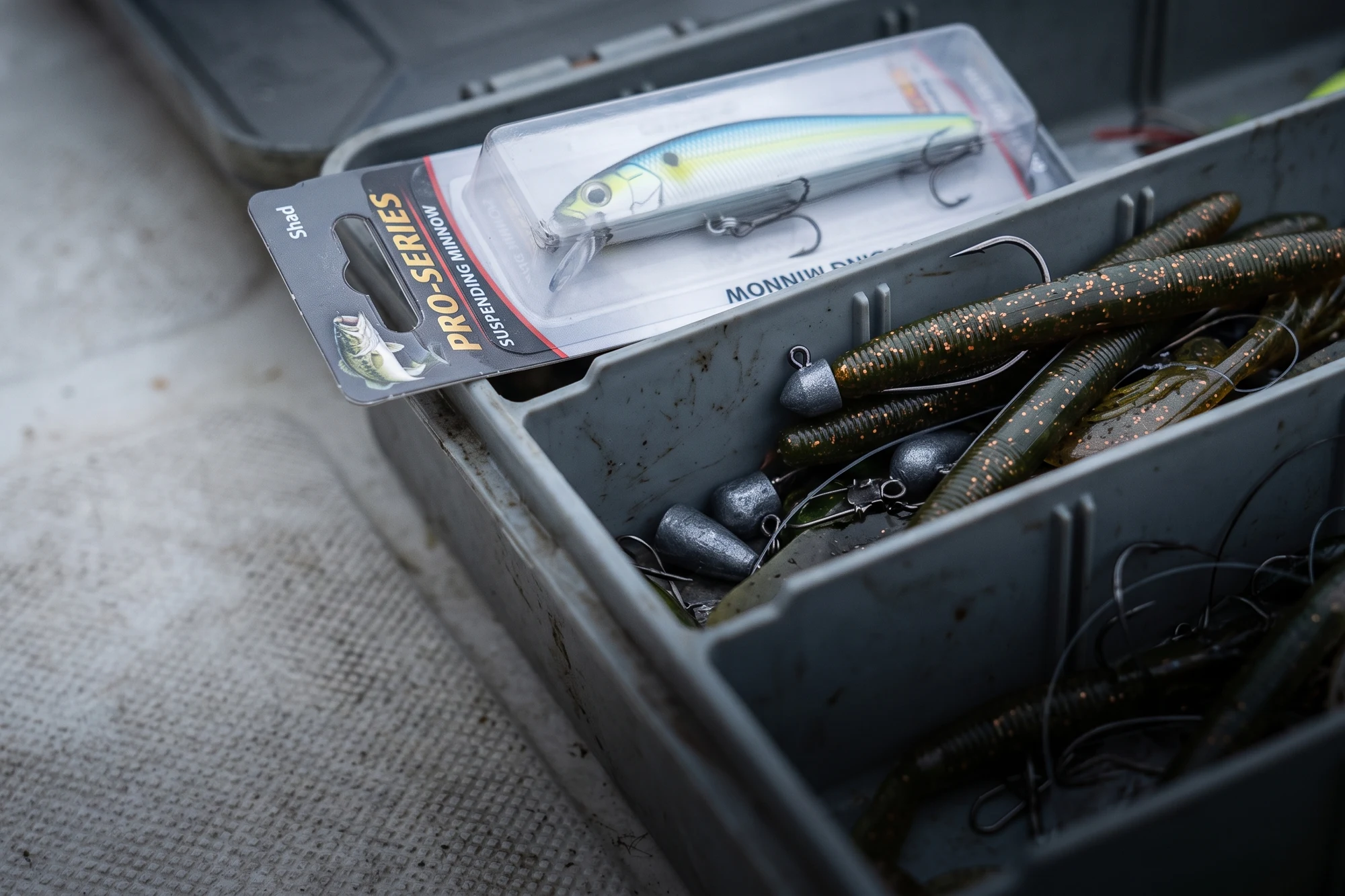
A jerkbait earns its strike through two things: flash from the lateral kick and profile on the freeze. A fish reads the dart, locks onto the shape, and bites during the pause because the bait looks like something that cannot escape. That chain of events requires the predator to see the lure far enough ahead to close the distance. In true darkness, that requirement fails.
This is not a debate about whether bass feed after dark. They do. Largemouth in particular are active on warm-summer nights, working shallow structure, dock edges, and transition points well past sunset. The question is not whether the fish are eating. The question is whether the mechanism your lure depends on still exists once the light is gone.
What a jerkbait actually needs from the water
In clear water, a bass can track a flashing jerkbait from roughly six to eight feet away. That tracking window is enough time to intercept a bait during the pause. Stained water shrinks that window fast: below about 18 inches of visibility, the fish cannot locate the bait before it is already past. True darkness takes that compression to its logical end.
A bass in dark water has a working lateral line, functional olfactory system, and reasonable hearing. Its eyes are present, photoreceptive, and mostly useless when there is no ambient light to work with. The jerkbait is still darting and pausing. Nothing is watching.
The lure did not stop working. The condition that allows it to work is gone.
Low light is not dark
This is the distinction that matters most in practice, and most night-fishing conversations skip it.
Dawn and dusk, roughly the hour on either side of sunrise and sunset, are the most productive jerkbait windows in warm weather. Light is present but diffuse. Bass that have moved shallow overnight are still active and have just enough ambient light to track a bait. Reaction strikes happen consistently in this window. The dart-and-pause sequence is fully intact.
Heavy overcast, even at midday, reduces surface light enough to push fish shallower and increase aggression. A jerkbait on a cloud-covered morning in otherwise clear water often outfishes a bright-sun day on the same water dramatically. This is still a visual mechanism. The light is reduced, not absent.
Then there is actual dark: no usable moon, no dock light in range, an hour or more past sunset on a clear night. This is where confidence in the jerkbait becomes a ritual rather than a strategy. The practical test is blunt: if you can see the lure when it surfaces at the end of a retrieve, enough light exists to fish it. If you cannot see the bait at all, you are past the useful threshold.
What to reach for when the jerkbait stops making sense
The presentations that produce in true darkness share one trait: they generate input the fish can track through its lateral line and hearing before its eyes need to be involved. Bass can feel pressure displacement and vibration at distances that exceed their useful night vision by a wide margin. Build the presentation around those senses, not the ones that are effectively offline.
Spinnerbait. A slow-rolling spinnerbait is one of the most consistent night producers in warm-water bass fishing. A 3/8 to 1/2 oz Colorado-blade spinnerbait retrieved just above the bottom or through shallow structure generates a pressure wave a bass can locate and intercept without ever seeing the bait until it is already in range. Black and dark blue skirts outperform shad patterns at night: the reason is silhouette contrast against a slightly lighter surface above, not the fish reading actual color. Keep the retrieve steady and slow. The blade needs to tick structure, not cruise through open water.
Bladed jig. A vibrating jig (sometimes called a chatterbait-style bladed jig) adds a lateral blade flutter to the pressure wave, increasing both the noise and the displacement signature. This is the better call when working grass or through laydowns after dark: the blade's erratic contact with structure creates both a vibration trigger and an acoustic one. Fish it on a slow to moderate steady retrieve, rod low, running it through cover rather than across open bottom. It works through the same sense as the spinnerbait, just with more audible output when it hits things.
Noisy topwater. The Heddon Zara Spook and any walk-the-dog bait with audible side-to-side splash are legitimate night choices, but they work through a different logic than daytime topwater. After dark, the sound signature at the surface is the trigger: a rhythmic splashing that a bass can locate and track from a distance. The retrieve needs to be slower at night than at dawn because the fish is navigating by sound, not sight. A frantic pace covers too much distance for the fish to intercept precisely. A deliberate one-splash-pause rhythm at roughly half your normal daytime walk-the-dog speed gives the fish enough time to find the source and commit.
Lipless rattlebait. A Strike King Red Eye Shad or a Rat-L-Trap slow-rolled along the bottom or just above grass does what the spinnerbait does with an added rattle that carries well through the water column. The vibration and acoustic combination covers more sensory ground than a blade alone. The tradeoff is hangups: a lipless bait catches grass on every other cast in heavy vegetation where a spinnerbait comes through cleaner. Choose based on the bottom structure you are working.
Dock lights: where the jerkbait comes back
Dock lights are the exception that proves the rule. A strong underwater dock light creates an illuminated zone, typically 10 to 20 feet of visible water, where jerkbaits produce at night. Baitfish stack in the light column. Bass stack around and below them. The jerkbait is operating in enough ambient light for the visual reaction mechanism to fire normally.
If you have a dock light in range: fish it. Work the edge of the shadow line rather than inside the lit cone, retrieve from dark water into light, and use the standard dart-and-pause cadence you would use at dawn. This is the one scenario at night where the visual chain is intact and the jerkbait is the right tool.
Outside the lit zone, past where you can see the bait, you are back to vibration-forward presentations. The jerkbait goes back in the box.
The decision before you tie on
Low light, first or last hour of the day, or heavy cloud cover: jerkbait is appropriate. Slower retrieve, shallower in the water column, brighter colors if the light is especially flat.
Dock light or other ambient light source you can see the bait by: fish the shadow edge with the jerkbait. Work from dark to light.
True dark with no useful light: spinnerbait or bladed jig for moving structure, noisy topwater as a locating presentation, lipless rattlebait for open bottom. The same logic that applies to stained water applies here: when the visibility is gone, the lure that depends on visibility is the wrong call.
The jerkbait is in the box. It will be there at first light, when the visual mechanism is back online and the bass are still shallow. The full hard-jerk selection for bass is ready for that window. Tonight is for something else.