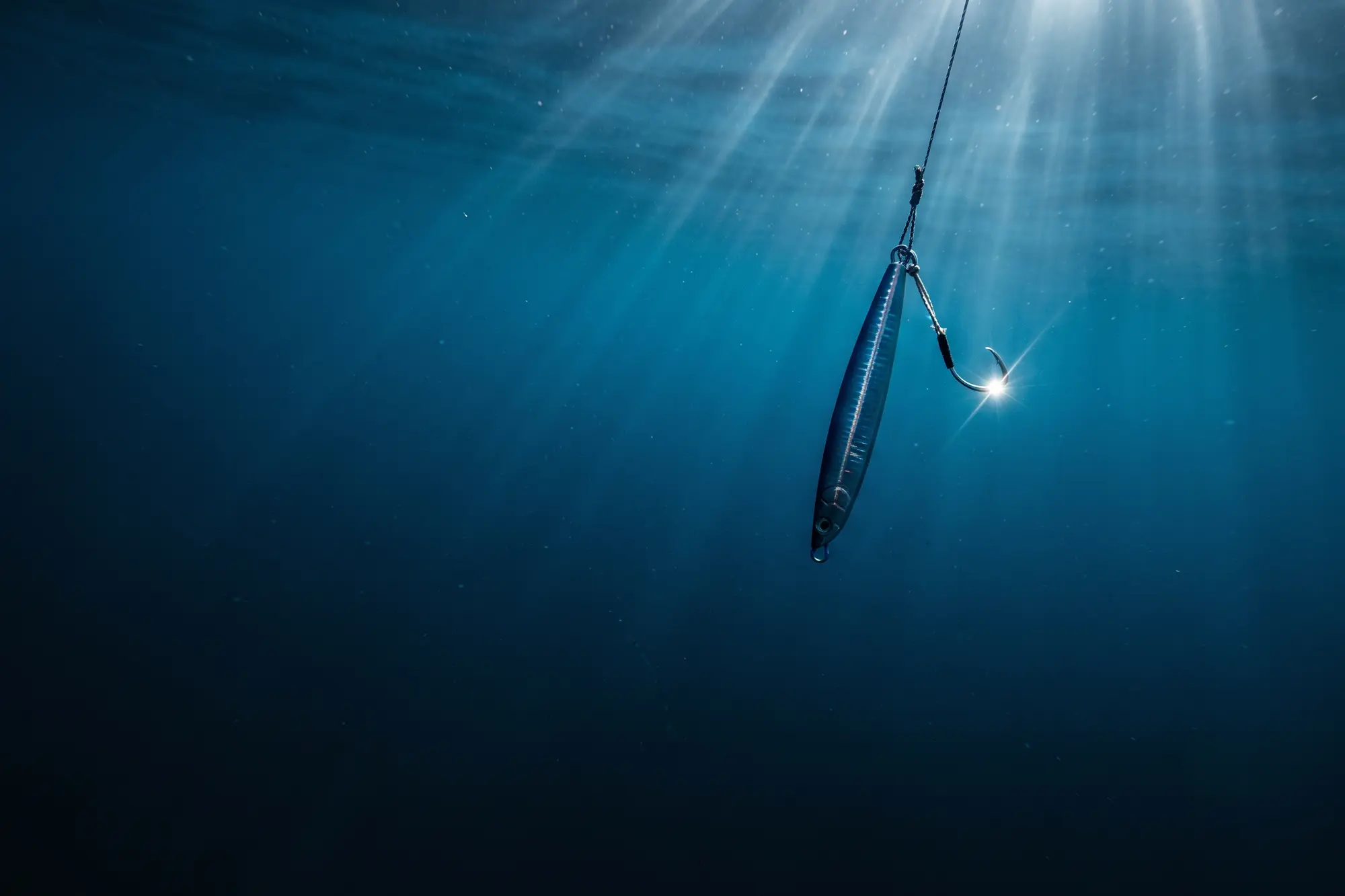
Saltiga is Daiwa's flagship name, the one attached to four-figure reels built for guys who fight tuna for a living. Putting that name on a $25 speed jig invites skepticism, and it should: a jig has no drag system, no gears, nothing mechanical to justify a flagship badge. What it does have is a center-balanced shape and a finish, and those two things are the entire pitch.
Center-balanced vs. tail-weighted: why it matters
Most budget speed jigs are tail- or head-weighted, which makes them fall in a predictable, fairly straight line. A center-balanced jig like the Saltiga SK is designed to flutter and kick erratically on the drop. It doesn't want to fall straight, and that instability is the entire selling point. An erratic fall reads as a wounded or dying baitfish to anything looking up from below. A straight fall reads as nothing at all.
The tradeoff: an erratic faller is harder to control on the retrieve than a straight-falling jig, and it takes a few drops to learn how much slack to feed it before the flutter kicks in. Feed too much line and it tumbles without direction; feed too little and it falls like a rock. The sweet spot is a controlled semi-slack line: enough for the jig to move, not so much that you lose contact.
The finish is doing real work
Daiwa's finish on the SK line uses a holographic prism foil under a thick clear coat, which survives toothy fish and repeated strikes against structure far longer than a painted finish. Cheaper speed jigs chip within a session or two; the flash disappears with the paint. The Saltiga's finish is the actual durability argument for the price, not the metal, which is the same lead or zinc alloy every other jig in this weight class uses.
Assist hook setup
The SK Jig ships without assist hooks pre-rigged in most sizes. Budget for a quality assist hook and solid ring separately if the listing you buy doesn't include them. A single assist hook at the head is standard for slow-pitch style jigging; a double assist (head and tail) adds hookup percentage on short-striking fish but costs you some of the flutter action on the fall.
Does it beat a cheaper knockoff?
Generic center-balanced speed jigs in the same weight range exist for $10–$15 and will catch fish. The Saltiga's edge is consistency across a session: the flutter pattern repeats more predictably drop after drop, and the finish outlasts a full day of bites and hook removals where a cheaper jig is visibly chipped by lunch. For an occasional angler, the cheaper jig is fine. For someone jigging multiple trips a season, the Saltiga's finish durability alone justifies the gap.
Verdict
Buy the Saltiga SK if you're jigging regularly enough that finish durability and drop-to-drop consistency matter, and you're willing to learn the slack-line technique an erratic-fall jig demands. It's not a beginner's first speed jig. Start with a straight-falling budget jig to learn depth and cadence, then step up to the Saltiga once you're ready to work the flutter.