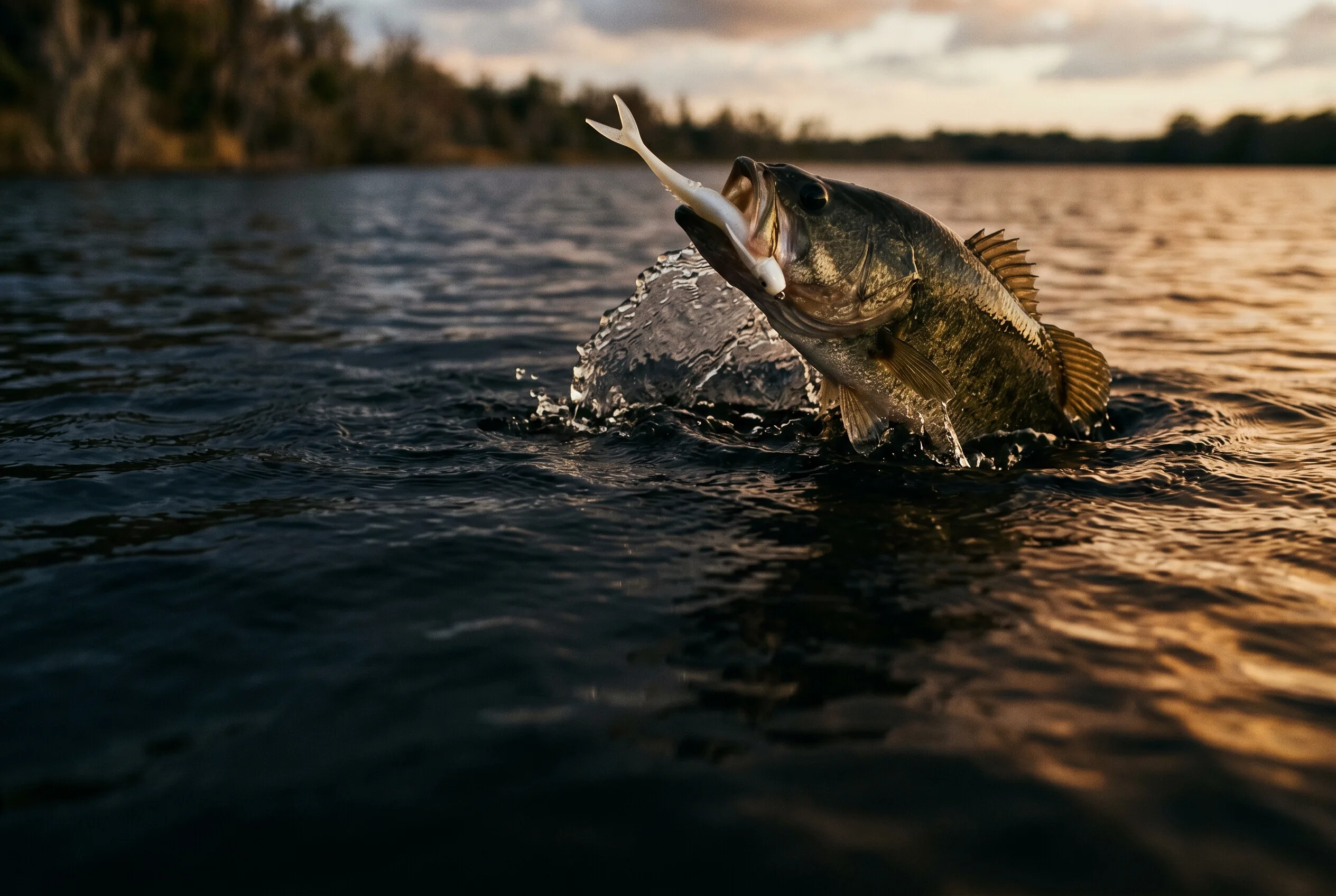
The soft jerkbait is the most forgiving lure in your tackle box. No hardware to misalign, no buoyancy to tune, no factory hooks to upgrade. Just a piece of salt-impregnated plastic that imitates a dying baitfish when you work it right and imitates a falling leaf when you do not. Understanding the difference is what separates anglers who throw flukes from anglers who catch fish on flukes.
What makes a soft jerkbait different from a hard one
The action comes from the plastic, not the lip. A hard jerkbait has a fixed swimming depth and a programmed dart direction built into its bill angle. A soft jerkbait does what physics and your rod tip tell it to. Pull right, it goes right. Pull down, it dives. Let it fall weightless and it shimmies toward the bottom on a path no hard bait can replicate.
That undisciplined fall is the point. Bass see it as a baitfish that has given up. Something has gone wrong with this minnow. It cannot control itself. That is the moment a bass decides it has found an easy meal.
The weightless rig: the only setup you need to start
Thread a 3/0 or 4/0 offset worm hook through the nose of the bait, skin-hook the point just below the surface of the back, and you are done. No split shot, no nail weight, no hardware. The bait should hang roughly horizontal on the hook with a slight tail droop.
Cast it, let it sink on a semi-slack line, watch where your line enters the water. When the bait hits bottom or you see the line jump, you have had a bite. The strike often happens during the fall, before you ever impart any action.
The cadence: less is more
Soft jerkbaits require half the rod action of hard jerkbaits. The bait is lighter and responds to smaller inputs. Two short twitches, each no more than six inches of rod tip travel, followed by a two-to-four second pause is the standard cadence in warm water. In cold water, push the pause to six seconds and reduce the twitch to four inches.
The mistake most anglers make: jerking too hard. A hard jerk launches a soft jerkbait out of the strike zone. You want a controlled flick that makes the tail kick, not a snap that puts the bait two feet higher in the column than you intended.
Color: the honest answer
Most of the time, white or chartreuse. In clear water, shad-colored or natural silver. In stained water, watermelon or junebug. The honest answer is that bass eating soft jerkbaits are usually reacting to movement, not color, and a white Zoom Super Fluke will out-fish an elaborate color-match on most days.
The exception is heavily pressured water, where fish have seen thousands of white flukes. In those conditions the off-color (electric chicken, bubblegum) can produce on days the standard colors go cold.
When to throw soft instead of hard
The soft jerkbait wins in calm conditions. Slick water, no wind, sunny skies, pressured fish: situations where a hard jerkbait's hardware noise and flash alert the fish to something artificial. A weightless soft jerk makes almost no noise on entry and falls silently. In those conditions it regularly out-fishes hard baits that cost four times as much.
The hard jerkbait wins in cold water (under 50°) and choppy conditions where the rattle and precise suspend action are advantages. Use soft for finesse conditions, hard for power conditions. When in doubt, throw soft first.
Three picks that catch fish
- Zoom Super Fluke 5": the standard. The bait that defined this category and still sets the benchmark for action and fall rate at under $10 a bag.
- Yamamoto D-Shad: heavier salt content, slower and more deliberate fall, cult status in tournament fishing. The Japanese fluke with an opinion about itself.
- Strike King Z-Too: the budget pick that walks well and comes in colors that, frankly, should not work as well as they do. At under $8 a bag, losing one to structure does not hurt.
See all picks in the weightless soft jerks filter, or browse the full Soft Jerks category.